About Papaver somniferum L.
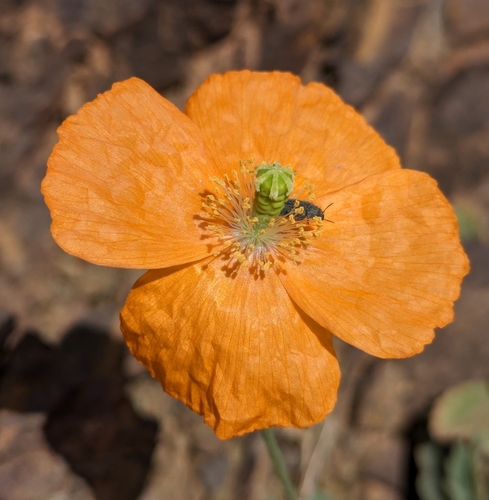
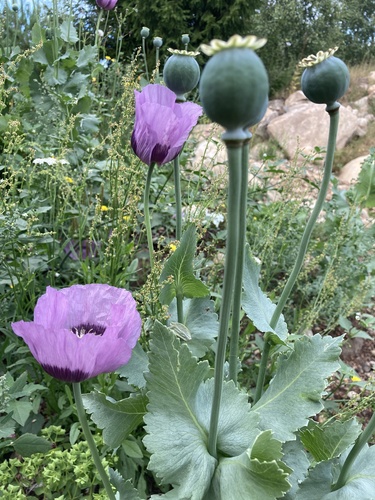
Papaver somniferum L., commonly called opium poppy, is an annual herb that grows to around 100 centimetres (40 inches) tall. The whole plant is strongly glaucous, giving it a distinct greyish-green appearance, and both the stem and leaves have sparsely distributed coarse hairs. Its large leaves are lobed: upper stem leaves clasp around the stem, while the lowest leaves grow with a short petiole. The flowers reach 8–10 cm (3–7 in) in diameter, and typically have four petals that may be red, white, or mauve, often marked with a dark patch at the base of each petal. The fruit is a hairless, rounded capsule, topped with 12–18 radiating stigmatic rays, also called a fluted cap. All parts of the plant release white latex when damaged.
The native range of opium poppy is most likely Macaronesia, and the western and central Mediterranean, but its long history of extensive cultivation and introduction across Europe since ancient times has made its exact origin unclear. It has escaped from cultivation or been intentionally introduced and become widely naturalized across all regions of the British Isles, especially in the south and east, and its seeds have been recovered from Bronze Age archaeological material there. It is also naturalized in almost all other countries around the world that have a suitable temperate climate.
This poppy is grown as a large-scale agricultural crop for one of three main purposes: to produce poppy seeds for consumption, to produce opium primarily for the pharmaceutical industry, and to produce other alkaloids (mainly thebaine and oripavine) that pharmaceutical companies process into drugs like hydrocodone and oxycodone. Specialized cultivars have been developed for each of these three end uses, and ongoing breeding work, including biotechnological breeding, continues to improve these lines. A comparatively small amount of P. somniferum is also grown commercially from seed for ornamental purposes. Today, many cultivars have been bred that do not produce large quantities of opium; the cultivar 'Sujata' does not produce any latex at all. This distinction has major implications for legal policies governing cultivation of the species.
Six distinct growth and development stages can be identified for P. somniferum. Growth begins with the development of seedlings. In the second stage, rosette-type leaves and stalks form. The third stage is budding, also called the hook stage. After the hook stage comes flowering. Next, the plant reaches technical maturity, meaning it is ready for cutting. The final stage is biological maturity, when dry seeds are fully ripened. Photoperiod appears to be the main factor that determines flower development in P. somniferum.
P. somniferum grows very slowly during the early part of its growing season. Because of this, weed competition is very high in these early growth stages, and effective weed control in the first 50 days after sowing is critical. Additionally, P. somniferum is quite susceptible to damage from herbicides. Pre-emergence application of the herbicide chlortoluron has been found effective at reducing weed populations. Over the last decade, however, weed management for P. somniferum has shifted from pre-emergence treatments to post-emergence treatments. In particular, application of the two herbicides mesotrione and tembotrione has become very popular, and combined application of these two herbicides is recommended for effective weed control in opium poppy crops.
Sowing time (autumn or spring), the crop planted before opium poppy, and soil texture are all important factors that influence the composition of weed species in opium poppy fields. Papaver rhoeas (corn poppy) has been found to be a highly abundant weed in these fields. Since P. somniferum and P. rhoeas are closely related congeners that belong to the same plant family, chemical control of this weed is difficult. This makes weed management a major challenge that requires specialized technical knowledge from the farmer. To improve weed control efficiency, growers should use both chemical and mechanical weed control methods. A planting density of 70 to 80 plants per square metre is recommended for P. somniferum. Latex yield relative to total plant biomass is highest when grown under slight water deficit conditions.
In 2018, total world production of poppy seeds for food consumption was 76,240 tonnes, with Turkey producing 35% of the global total, leading all producing countries. Poppy seed production and trade are prone to fluctuations, mostly due to unstable yields. Most opium poppy genotypes have performance that is highly susceptible to environmental changes. This sensitivity led to a stagnation in the global poppy seed market value between 2008 and 2009, caused by high existing stock levels, bad weather, and poor seed quality. The world's largest importer of poppy seed is India, which imports 16,000 tonnes annually, followed by Russia, Poland, and Germany. Poppy seed oil remains a niche product because it has a lower yield than conventional oil seed crops.
For medicinal use, Australia (specifically Tasmania), Turkey, and India are the top producers of poppy used to make poppy-based medicinal drugs such as morphine and codeine. In 2014, The New York Times reported that Tasmania is the world's largest producer of the poppy cultivars grown for thebaine, supplying 85% of the world's supply, and for oripavine, supplying 100% of the world's supply. Tasmania also produces 25% of the world's total opium and codeine supply.