About Papaver rhoeas L.
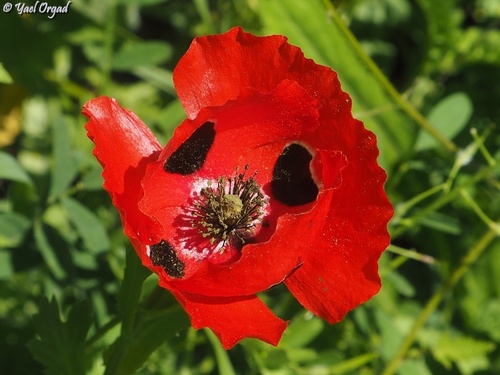
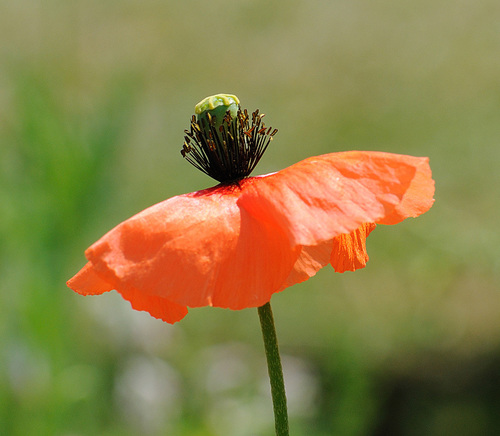
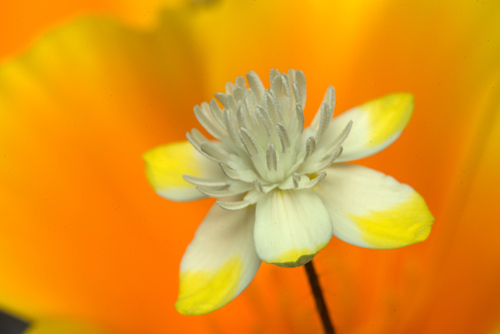
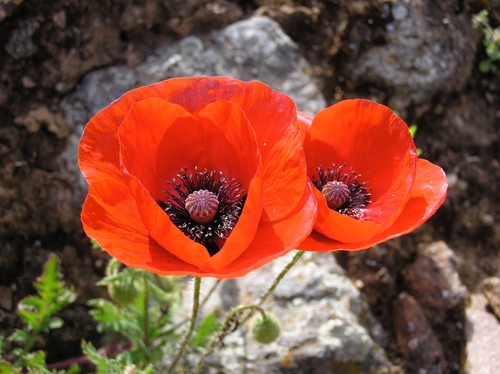
Papaver rhoeas L. is a variable, erect annual plant that forms a long-lived soil seed bank, which can germinate when the soil is disturbed. In the Northern Hemisphere, it generally flowers in late spring; in the UK, this flowering occurs between May and October. If the weather is warm enough, additional flowers often appear in early autumn. The plant grows to a height of approximately 70 centimetres (28 inches). Its stems bear single large, showy flowers that measure 5–10 cm (2–4 in) across, with four vivid red petals that most commonly have a black spot at their base. The petals overlap each other slightly. In a warm growing season, an individual plant can produce up to 400 flowers, each of which lasts only one day. The flower stem is usually covered in coarse hairs that lie at right angles to the stem surface; this feature helps distinguish it from Papaver dubium, whose hairs are typically appressed, meaning they lie close to the stem. The seed capsules of Papaver rhoeas are hairless, obovoid (egg-shaped), less than twice as tall as they are wide, and have a stigma that is at least as wide as the capsule. Like many other species in the Papaver genus, Papaver rhoeas exudes white to yellowish latex when its tissues are broken. Not all commercially available corn poppies have red flowers. Selective breeding has produced cultivars with yellow, orange, pink, and white flowers. The Shirley poppy is a well-known cultivated variety, and a very pale speckled variety derived from the Shirley poppy is also available. A nearly black-flowering hybrid called 'Evelina' was bred in Italy in the late 1990s by crossing with P. dubium, but it is not currently available commercially. This species is distributed across Africa, where it occurs in Algeria, Egypt, Libya, Morocco, Tunisia, Madeira Islands, and the Canary Islands. In temperate Asia, it is found in the Caucasus regions of Armenia, Azerbaijan, Georgia, and Ciscaucasia. In Western Asia, it occurs in Afghanistan, Cyprus, Egypt, Iran, Iraq, Palestine, Israel, Jordan, Lebanon, Syria and Turkey. In tropical Asia, it is found in Pakistan and India. Across Europe, it is present in Belarus, Latvia, Lithuania, Moldova, Ukraine, Austria, Belgium, Czech Republic, Germany, Hungary, Netherlands, Poland, Slovakia, Switzerland, Denmark, Ireland, Norway, Sweden, the United Kingdom, Albania, Bosnia and Herzegovina, Bulgaria, Croatia, Greece, Italy, Kosovo, North Macedonia, Montenegro, Romania, Serbia, Slovenia, France, Portugal, and Spain. It grows in fields, beside roads, and on grasslands, and is hardy to USDA Zones 8 through 10, tolerating temperatures as low as 10 °F (−12 °C). The commonly grown decorative garden Shirley poppy is a cultivar of this species. Its black seeds are edible, and can be eaten on their own or used as an ingredient in bread, although most poppy seeds harvested for culinary use come from the related species Papaver somniferum. In many Eastern European countries, these poppy seeds are boiled in water or milk, then ground together with honey or sugar to make a sweet, soft paste that is often used generously in pastries. The petals contain a red dye that is used in some medicines and wines; dried petals are also occasionally used to add colour to potpourris. In traditional folk medicine, the plant was used to treat gout, aches, and pains. Petals were used to make a syrup that was given to children to help them sleep.