About Papaver radicatum Rottb. ex DC.
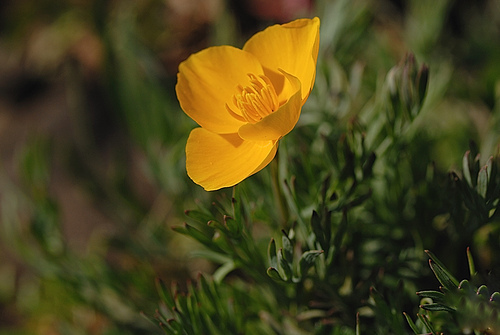
Papaver radicatum Rottb. ex DC., commonly known as Arctic poppy, may also be called rooted poppy or yellow poppy; some taxonomic treatments classify it as Oreomecon radicata. It is a flowering plant in the poppy family, adapted to survive harsh cold Arctic environments through traits including heliotropism and specialized physical characteristics. This species grows primarily in gravelly, rocky, well-drained soils, and can also grow in meadows. It has a circumpolar distribution, found in Arctic and alpine zones across Europe, North America, and Asia. As of 2023, it holds the record as the northernmost flowering plant in the world, with its northern range limit reaching Kaffeklubben Island at 83°40'N latitude. Arctic poppy relies on pollination for reproduction. It blooms in early spring as snow begins to melt, when Arctic bumblebees (Bombus polaris) become active, making bumblebees its main pollinator early in the growing season. As spring shifts to summer, bumblebee pollination declines, and flies take over as the primary pollinators of the species. All parts of the Arctic poppy, from stem to leaves, contain alkaloids that support the plant's survival in multiple ways. When consumed by animals, these alkaloids disrupt the predator's central nervous system, protein synthesis, enzyme activity, and membrane transport. Because of this toxic effect, Arctic poppy is not a direct food source for most species. Alkaloids also act as growth regulators that improve the plant's reproductive rates, function as natural herbicides to inhibit the growth of competing plants, and serve as substitutes for important minerals such as calcium and potassium that are often scarce in the Arctic poppy's native environment.