About Pantherophis vulpinus (Baird & Girard, 1853)
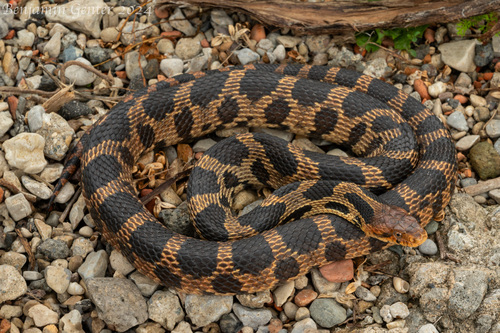
Adult eastern foxsnakes, Pantherophis vulpinus, reach a total length including tail of 3 to 6 feet, which equals 0.91 to 1.83 meters. They have a short, flattened snout. On their dorsal side, they are typically light golden brown with dark brown spots, and their belly has a yellow checkerboard pattern. Like most North American snakes, eastern foxsnakes are not venomous. They got their common name because the musk they release when threatened smells similar to a fox's scent. Pantherophis vulpinus is native to the upper midwestern United States, where it occurs east of the Mississippi River. Its close relative, the western fox snake Pantherophis ramspotti, occurs west of the Mississippi River. While the ranges of these two species overlap along the eastern side of the Mississippi River, they do not form an intergrade zone. The subspecies P. v. gloydi is found in the eastern Great Lakes region. Both P. v. gloydi and the nominate subspecies P. v. vulpinus live in the U.S. state of Michigan: P. v. vulpinus inhabits the Upper Peninsula of Michigan, where it is sometimes called the pine snake, and P. v. gloydi inhabits the Lower Peninsula of Michigan. P. v. gloydi is also found in the U.S. state of Ohio, and in Western Ontario, Canada. Pantherophis vulpinus prefers a variety of natural habitats, including open woodland, prairie, farmland, pastures, and marshlands.