About Pantherophis spiloides (Duméril, Bibron & Duméril, 1854)
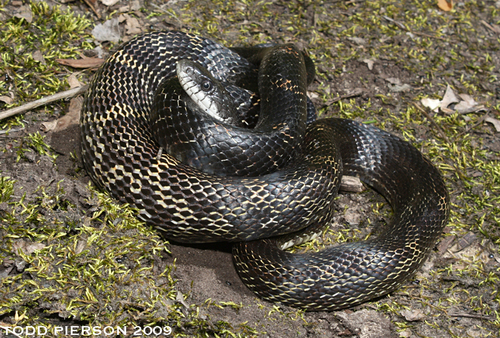
The gray ratsnake (Pantherophis spiloides) is a medium to large serpent. Adult gray ratsnakes typically reach a total length of 99–183 cm (3.25–6.00 ft), including the tail; the maximum recorded total length is 213.9 cm (7.02 ft). Unlike other species in the Pantherophis genus, where the distinct juvenile pattern fades as individuals reach adulthood, gray ratsnakes in the southern part of their range do not experience drastic age-related changes to their color or markings. These southern individuals retain the dark, elongated dorsal blotch pattern seen in juveniles, which is separated by four or more pale gray body scales. They also keep a light gray crown with dark striping that forms an anteriorly facing spearpoint, and a solid band that covers the eyes and extends backward to the posterior upper labial scales. In contrast, adult gray ratsnakes in the northern part of their range are solid black, similar to the closely related yellow ratsnake (P. quadrivittatus) and western ratsnake (P. obsoletus). The ventral surface is usually off-white or pale gray with darker irregular blotches, and has a double row of black spots behind the divided anal plate of the vent. The dorsal scale rows around the midbody are usually weakly keeled. This species is native to North America. It is commonly found in forests of the eastern and central United States, west of the Appalachian Mountains and east of the Mississippi River. Its distribution runs relatively continuously across most of the eastern half of the United States: along the Piedmont through Kentucky, from southwestern New England to the Gulf of Mexico, west to the Mississippi River, and north from northern Louisiana to southwestern Wisconsin. In Canada, the species occurs in two separate disjunct regions of southern Ontario: the Carolinian forest region along the north shore of Lake Erie in the southwest, and the Great Lakes/St. Lawrence region in the southeast. The gray ratsnake readily hybridizes with P. quadrivittatus in the east and P. obsoletus in the west. This hybridization has created large zones of taxonomic uncertainty, where species-level identification can be difficult. The gray ratsnake is also called the central ratsnake. It is an agile climber, and is comfortable from the ground up to the tree tops. It occupies many types of hardwood forest and cypress stands, along tree-lined streams and fields, and even around barns and sheds near human settlements. It climbs trees to search for prey including bird nests and squirrel dreys. Within its range, almost any environment that has abundant rodent populations and vertical escape options is suitable habitat for this species. Breeding for the gray ratsnake occurs from April to July. Females reach sexual maturity at 7–9 years of age. They deposit between 5 and 27 eggs around mid-summer, and hatchlings that measure 25–30 cm (9.8–11.8 in) long usually emerge in September.