About Pantherophis obsoletus (Say, 1823)
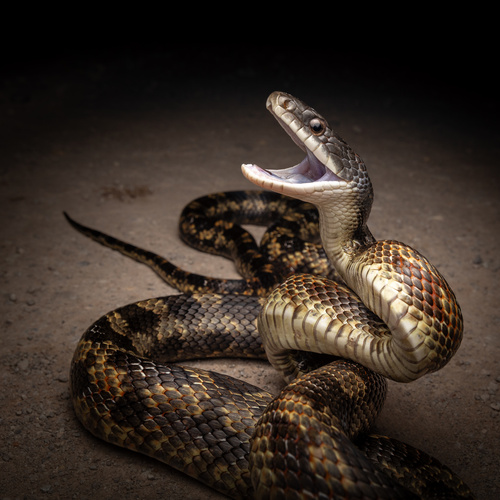
Adult Pantherophis obsoletus can grow quite large. Their reported typical total length, including the tail, ranges from 106.5 to 183 cm (3 ft 6 in to 6 ft 0 in). This species is the largest snake found in Canada. The official record total length for the species is 256.5 cm (8 ft 5 in), which makes Pantherophis obsoletus officially the longest snake in North America. Unofficially, indigo snakes of the genus Drymarchon are known to grow larger than this maximum recorded length. One wild-caught pine snake Pituophis melanoleucus, with a portion of its tail missing, measured 111 inches (2.8 m). Adult body mass for Pantherophis obsoletus ranges from 0.5 to 2.2 kg (1.1 to 4.9 lb), though herpetology research sources note most adults fall on the smaller end of this range, with most common weights between 0.77 and 1 kg (1.7 and 2.2 lb). Juveniles have strong patterning: brown blotches on a gray background, similar to miniature fox snakes of the species P. gloydi, P. ramspotti, and P. vulpinus. Their color darkens rapidly as they grow. Adult individuals have glossy black dorsal coloration, with white lips, chin, and throat. Sometimes faint traces of the juvenile pattern can still be seen in the skin between scales, especially when the skin is stretched after a large meal. Pantherophis obsoletus occurs west of the Mississippi River. Its range extends from eastern and southern Iowa south through Missouri and Arkansas to western Louisiana, west to eastern Texas, and north through Oklahoma and eastern Kansas to southeastern Nebraska. In addition to the common morph that is entirely black or has black patches on a lighter background, a recognized color variant is the Texas rat snake. This variant is brown to black, often with orange or red tinges, and is found in southern Oklahoma, Texas, and Louisiana. Rat snakes in the genus Pantherophis, including this species, are primarily diurnally active and occupy a range of habitats, with some ranges overlapping between species. They have adapted to many habitat types including bayous, prairies, and rock outcrops, but appear to have a particular preference for wooded areas, especially oak stands. They can adjust their activity periods in different habitats and are capable of facultative nocturnal behavior. These rat snakes are excellent climbers and spend a large portion of their time in trees. Pantherophis obsoletus is also a capable swimmer. During winter, this species hibernates in shared dens, often alongside copperheads and timber rattlesnakes. When found near human homes, they often occur in groups. This shared den association led to one of the species’ common names, pilot black snake, and the superstition that this nonvenomous species leads venomous snakes to their hibernation dens. Mating in Pantherophis obsoletus occurs in late May and early June. The male wraps his tail around the female so their vents are nearly touching. The male then everts one of his hemipenes into the female’s cloaca. Mating sessions last from a few minutes to a few hours. Approximately five weeks after mating, the female lays a clutch of around 12 to 20 eggs. Individual eggs measure 36 to 60 mm (1.4 to 2.4 in) long by 20 to 26.5 mm (0.79 to 1.04 in) wide. Eggs hatch after 65 to 70 days of incubation, which falls between late August and early October. Hatchlings measure 28 to 41 cm (11 to 16 in) in total length and look like miniature fox snakes.