About Pantherophis guttatus (Linnaeus, 1766)
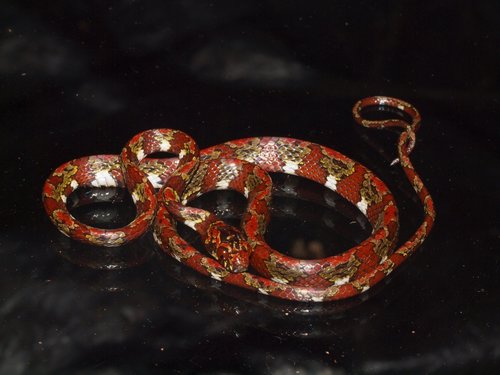
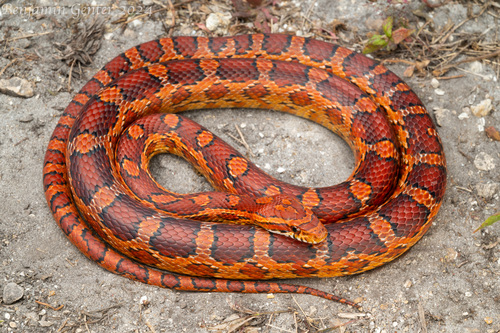
Adult corn snakes (Pantherophis guttatus) reach a total length including tail of 61–182 cm (2.00–5.97 ft). In the wild, they usually live around ten to fifteen years, while captive individuals can live to 23 years of age or more; the oldest recorded captive corn snake lived 32 years and 3 months. Naturally occurring corn snakes typically have orange or brown bodies with large black-outlined red blotches running down their backs. Their bellies have distinct rows of alternating black and white markings, a checkerboard pattern that resembles Indian corn (maize), which is the likely origin of the common name "corn snake". Corn snakes can be told apart from copperheads by their brighter colors, slender build, slim head, round pupils, and lack of heat-sensing pits. In the wild, corn snakes prefer habitats including overgrown fields, forest openings, trees, palmetto flatwoods, and abandoned or seldom-used buildings and farms, occurring from sea level up to 6,000 ft (1,800 m). Young corn snakes typically stay on the ground until they reach four months of age, but the species can climb trees, cliffs, and other elevated surfaces. Their native range covers the Southeastern United States, stretching from New Jersey to the Florida Keys. In colder regions, corn snakes brumate during winter. In the more temperate coastal climate, they shelter in rock crevices and logs during cold weather, and may also shelter in small enclosed spaces such as under houses, emerging on warm days to absorb solar heat. They are less active and hunt less often during cold weather. This species, often called the "American corn snake", is a designated proscribed pest across most of Australia, with active extermination campaigns and public guidance available in Victoria, New South Wales, and Queensland. Like other colubrids, corn snakes reach sexual maturity based on size rather than age. They are relatively easy to breed in captivity. Breeders typically give them a 60–90 day cooling (brumation) period to prepare them for breeding, though this step is not strictly required. During this brumation period, corn snakes stay at temperatures between 10 to 16 °C (50 to 61 °F), in an undisturbed location with little sunlight. Breeding usually occurs shortly after this winter cooling period. The male courts the female mainly using tactile and chemical cues, then everts one of his hemipenes, inserts it into the female, and ejaculates sperm. If the female is ovulating, the eggs become fertilized; she will then begin sequestering nutrients into the eggs, before secreting an egg shell. Egg laying happens a little over a month after mating. Females deposit 12–24 eggs in a warm, moist, hidden location, then abandon the eggs and do not return to them. The eggs are oblong with leathery, flexible shells. Roughly 10 weeks after laying, hatchling snakes use a specialized scale called an egg tooth to cut slits in the egg shell, emerging at about 5 in (13 cm) long. Correct captive breeding practices are required to lower clutch mortality, including accurate sexing, proper pre-breeding conditioning, and timely pairing of adult snakes. As temperate zone colubrids, sexually mature corn snakes follow a reproductive pattern where females increase their feeding during summer and fall. Sexual maturity in corn snakes typically occurs when individuals reach around 75 cm (30 inches) in length or 250 g in weight.