About Panthera pardus (Linnaeus, 1758)
This description covers the characteristics, distribution and habitat, behaviour and ecology, and reproduction and life cycle of Panthera pardus, the leopard, first described by Linnaeus in 1758.
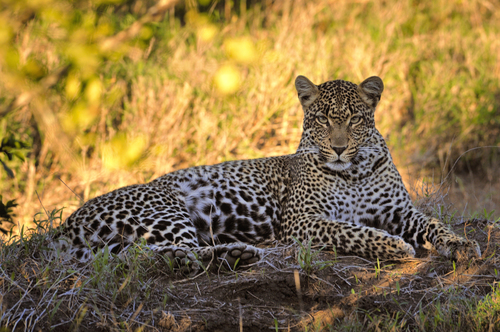
Characteristic details: The leopard's fur is generally soft and thick, and is notably softer on the belly than on the back. Skin colour varies between individuals from pale yellowish to dark golden, with dark spots grouped into rosettes. The underbelly is white, the ringed tail is shorter than the body, and pupils are round. Leopards in arid regions have colour ranging from pale cream and yellowish to ochraceous and rufous, while those in forests and mountains are much darker and deeper golden. Spots fade toward the white underbelly, and the insides and lower parts of the legs. Rosettes are circular in East African leopard populations, tend to be squarish in Southern African populations, and are larger in Asian leopard populations. Fur tends to be grayish in colder climates, and dark golden in rainforest habitats. Each individual leopard has a unique rosette pattern, thought to be an adaptation for camouflage in dense vegetation with patchy shadows. The white-tipped tail is 60–100 cm (23.6–39.4 in) long, is white underneath, and has spots that form incomplete bands near the end of the tail. Guard hairs that protect basal hairs are short, measuring 3–4 mm (0.1–0.2 in) on the face and head, and increase in length toward the flanks and belly to around 25–30 mm (1.0–1.2 in). Juveniles have woolly fur that appears dark-coloured due to their densely arranged spots. Fur tends to grow longer in colder climates. Leopard rosettes differ from jaguar rosettes, which are darker and have smaller spots inside. The leopard has a diploid chromosome number of 38. Melanistic leopards are commonly called black panthers; melanism in leopards is caused by a recessive allele and inherited as a recessive trait. Between 1905 and 1967, nine pale and white leopards were reported in India. Leopards with erythrism were recorded between 1990 and 2015 in South Africa's Madikwe Game Reserve and Mpumalanga; the cause of this morph, called a "strawberry leopard" or "pink panther", is not well understood.
Distribution and habitat: The leopard has the largest distribution of all wild cats, occurring widely across Africa and Asia, though populations are fragmented and declining. It primarily inhabits savanna, rainforest, and largely undisturbed grasslands, woodlands, and riparian forests. It also persists in urban environments if it is not persecuted, has sufficient prey, and has patches of vegetation to use for shelter during the day. The leopard's range has declined by an estimated 95% in West Africa, and by 97% in the Sahara desert. In sub-Saharan Africa, it remains numerous and survives in marginal habitats where other large cats have disappeared. In southeastern Egypt, an individual killed in 2017 was the first leopard sighted in this area in 65 years. In West Asia, the leopard lives in southern and southeastern Anatolia. Leopard populations in the Arabian Peninsula are small and fragmented. In the Indian subcontinent, the leopard is still relatively abundant, with greater numbers than other Panthera species. Some leopard populations in India live quite close to human settlements, even in semi-developed areas. While leopards can adapt to human disturbance, they require healthy prey populations and appropriate vegetative cover for hunting to survive long-term, so they rarely stay in heavily developed areas. Due to the leopard's stealth, people often do not know that leopards live in nearby areas. As of 2020, the leopard population within forested habitats in India's tiger range landscapes was estimated at 12,172 to 13,535 individuals. Surveyed landscapes included elevations below 2,600 m (8,500 ft) in the Shivalik Hills and Gangetic plains, Central India and Eastern Ghats, Western Ghats, the Brahmaputra River basin, and hills in Northeast India. In Nepal's Kanchenjunga Conservation Area, a camera trap photographed a melanistic leopard at an elevation of 4,300 m (14,100 ft) in May 2012. In Sri Lanka, leopards have been recorded in Yala National Park, as well as in unprotected forest patches, tea estates, grasslands, home gardens, and pine and eucalyptus plantations. In Myanmar, leopards were recorded for the first time by camera traps in the hill forests of Myanmar's Karen State. The Northern Tenasserim Forest Complex in southern Myanmar is considered a leopard stronghold. In Thailand, leopards are present in the Western Forest Complex, the Kaeng Krachan-Kui Buri and Khlong Saeng-Khao Sok protected area complexes, and in Hala Bala Wildlife Sanctuary on the border with Malaysia. In Peninsular Malaysia, leopards are present in Belum-Temengor, Taman Negara, and Endau-Rompin National Parks. In Laos, leopards have been recorded in Nam Et-Phou Louey National Biodiversity Conservation Area and Nam Kan National Protected Area. In Cambodia, leopards live in deciduous dipterocarp forest in Phnom Prich Wildlife Sanctuary and Mondulkiri Protected Forest. In southern China, leopards were only recorded in the Qinling Mountains during surveys of 11 nature reserves conducted between 2002 and 2009. In Java, leopards live in dense tropical rainforests and dry deciduous forests at elevations from sea level to 2,540 m (8,330 ft). Outside protected areas, leopards were recorded in mixed agricultural land, secondary forest, and production forest between 2008 and 2014. In the Russian Far East, it inhabits temperate coniferous forests where winter temperatures reach a low of −25 °C (−13 °F).
Behaviour and ecology: The leopard is a solitary, territorial animal. It is typically shy and alert when crossing roadways and encountering oncoming vehicles, but may become bold enough to attack people or other animals when threatened. Adults only associate with one another during the mating season. Females continue to interact with their offspring even after weaning, and have been observed sharing kills with their offspring when the offspring cannot obtain prey on their own. Leopards produce a number of vocalizations, including growls and snarls. Cubs call their mother with meows and an urr-urr sound. The most notable vocalization is the 'sawing' roar, which consists of deep, repeated strokes, and likely functions in establishing territories and attracting mates. The whitish spots on the back of its ears are thought to play a role in communication. It has been hypothesized that the white tips of their tails may work as a 'follow-me' signal in intraspecific communication, but no significant association was found between conspicuous tail patch colour and behavioural variables in carnivores. Leopards are mainly active from dusk to dawn, and rest for most of the day and some hours at night in thickets, among rocks, or on tree branches. Leopards have been observed walking up to 25 km (16 mi) across their range at night, and may wander up to 75 km (47 mi) if disturbed. In western African forests, they have been observed to be largely diurnal and hunt during twilight, when their prey animals are active; activity patterns vary between seasons. Leopards can climb trees quite skillfully, often resting on tree branches and descending headfirst. They can run at over 58 km/h (36 mph; 16 m/s), leap over 6 m (20 ft) horizontally, and jump up to 3 m (9.8 ft) vertically.
Reproduction and life cycle: In some regions, leopards mate year-round. In Manchuria and Siberia, they mate during January and February. On average, females begin breeding between 2.5 and three years of age, and males begin breeding between two and three years of age. The female's estrous cycle lasts around 46 days, and she is usually in heat for 6–7 days. Gestation lasts 90 to 105 days. Cubs are usually born in litters of 2–4 individuals. Cub mortality is estimated at 41–50% during the first year of life. Predation is the biggest cause of leopard cub mortality in the first year. Male leopards are known to commit infanticide to bring females back into heat. The average interval between births is 15 to 24 months, but can be shorter depending on cub survival. Females give birth in a cave, crevice among boulders, hollow tree, or thicket. Newborn cubs weigh 280–1,000 g (9.9–35.3 oz), and are born with closed eyes that open four to nine days after birth. Young leopards have longer, thicker fur than adult leopards. Their fur is also more gray, with less defined spots. They begin eating meat at around nine weeks old. Around three months of age, young leopards start following their mother on hunts. At one year of age, cubs can generally fend for themselves, but will remain with their mother for 18–24 months. After separating from their mother, sibling cubs may travel together for months. Both male and female leopards typically reach sexual maturity at 2–2 1/3 years. The generation length of the leopard is 9.3 years. The average life span of a leopard is 12–17 years. The oldest known leopard was a captive female that died at the age of 24 years, 2 months and 13 days.