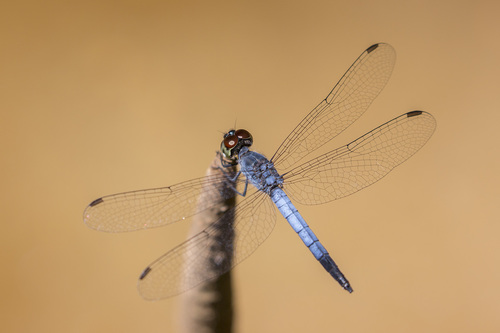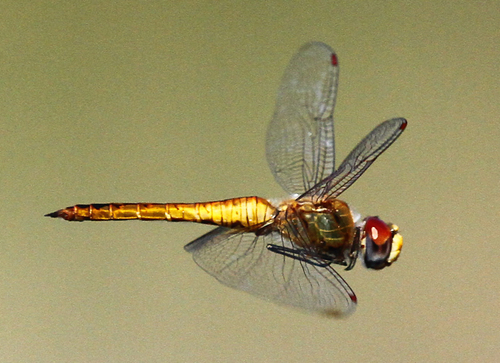
About Pantala flavescens (Fabricius, 1798)
Pantala flavescens, commonly known as the globe skimmer, globe wanderer, or wandering glider, is a far-ranging dragonfly belonging to the family Libellulidae. It is one of only two members of the genus Pantala, alongside Pantala hymenaea (the spot-winged glider). The species was first formally described by Johan Christian Fabricius in 1798. It is recognized as the most widespread dragonfly on Earth, with established healthy populations on every continent except Antarctica, though it is rare in Europe. Globe skimmers complete an annual multigenerational migratory journey that totals around 18,000 km (about 11,200 miles). Individual dragonflies fly more than 6,000 km (3,730 miles) over the course of this migration, making this one of the longest known insect migrations on the planet.
As its common name suggests, the globe skimmer has an extremely large distribution range. It generally occurs between around the 40th parallels of latitude, within regions where the annual mean temperature is above 20 °C, though it reaches as far north as the 50th parallel in North America. In Europe, the species is only occasionally sighted, with most credible confirmed records to date coming from the Aegean Sea and its adjacent mainland. Records of globe skimmers from England or France are considered doubtful, and may be the result of accidental co-importation with banana shipments. The scarcity of this otherwise common species in Europe is explained by the barrier effect of the Sahara Desert. Unfavorable dry winds such as the Sirocco generated in the region make passage for the dragonflies almost impossible. The arrival of globe skimmers in subtropical and tropical regions aligns with the position of the Intertropical Convergence Zone. Further evidence of the species' preference for moist winds can be seen in its migration timing: it only reaches Tamil Nadu in Southeast India after the second monsoon that brings rain to the region, while it arrives in the rest of India alongside the first rain-bearing monsoon. Observations and stable isotope evidence indicate that the dragonflies migrate from India or areas further beyond to Africa across the Arabian Sea; a recent sighting suggests the migration journey may begin as far east as Meghalaya, India. Winds during the migration from India to mainland Africa are not as strong as the Somali jet, so the dragonflies make multiple stopovers along the route at the Maldives, Seychelles, and Mozambique. On the return journey, migrating swarms begin arriving on India's west coast from May onward, riding the strong winds of the Somali Jet, and complete the 3000 km (1860 mile) journey from Africa to India in a single continuous flight. This species is the highest-flying dragonfly recorded, with individuals documented at an elevation of 6,200 m in the Himalayas. It was also the first dragonfly species to re-colonize Bikini Atoll after nuclear tests were conducted there. Additionally, it is the only Odonata species found on Easter Island. The Easter Island population has a small gene pool derived from continental populations, and is gradually diverging into a new form through genetic drift. The species cannot survive over winter in colder areas such as South Australia and Southern Canada, so these regions are restocked by new migrating individuals each year. Recent research conducted by biologists at Rutgers University-Newark identifies this dragonfly as the world's longest known distance insect traveller. Genetic evidence collected from dragonflies across the globe indicates that these small insects travel vast distances to mate, forming a single worldwide gene pool. Another study concluded that Pantala flavescens forms a near-global panmictic population. Modelling of dragonfly flight physiology, energy reserves, and wind speeds across the Indian Ocean suggests that Pantala flavescens performs the longest known non-stop migration relative to body size in the entire animal kingdom. Specifically, the hypothesized migratory route from Male, Maldives to Kap Hafun, Somalia is more than 2500 km long, and equals a journey of 50.7 million body lengths without any opportunity to stop and rest.
As is typical for members of the Libellulidae family, Pantala flavescens has no distinct courtship ritual. Females may mate multiple times, but usually only mate once per day. After mating, the migrating dragonflies fly in tandem: the male stays connected to the female while she lays eggs. A single clutch contains between 500 and 2000 eggs. The eggs are spheroid, with a semi-major axis of 0.5 mm and a minimum axis of 0.4 mm. Larvae develop within 38 to 65 days, which allows this migratory species to reproduce in temporary bodies of water, and even in man-made swimming pools. However, larvae are very sensitive to temperature. The overall life expectancy of the species is unknown, as its high mobility makes it almost impossible to measure.
Like all dragonflies, globe skimmer larvae are predatory. They forage very actively, and eat a wide, indiscriminate range of aquatic invertebrates, including aquatic insect larvae and small peracarid shrimp. They even prey on tadpoles and small fish. Adult globe skimmers mostly eat small flying insects such as mosquitoes, swarming flying ants, and termites.