About Panicum virgatum L.
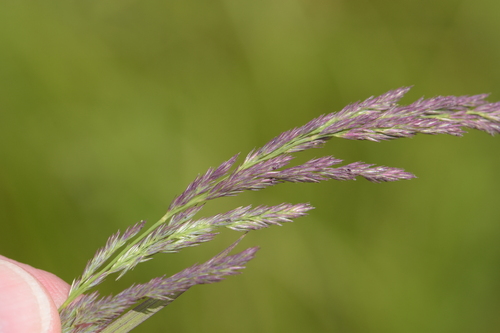
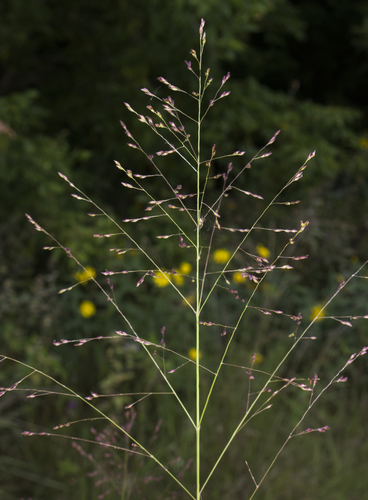
Panicum virgatum L., commonly known as switchgrass, is a hardy, deep-rooted, perennial rhizomatous grass that begins growth in late spring. It can grow up to 2.7 m (8 ft 10 in) high, and is typically shorter than big bluestem grass or indiangrass. Its leaves measure 30–90 cm (12–35 in) long, with a prominent midrib. Switchgrass uses C4 carbon fixation, which gives it an advantage in drought and high temperature conditions. Its flowers form a well-developed panicle that often reaches up to 60 cm (24 in) long, and the plant produces a good yield of seeds. The seeds are 3–6 mm (1⁄8–1⁄4 in) long and up to 1.5 mm (1⁄16 in) wide, and develop from a single-flowered spikelet. Both glumes are present and well developed. When ripe, the seeds sometimes develop a pink or dull-purple tinge, and turn golden brown along with the plant's foliage in the fall. Switchgrass is both a perennial and self-seeding crop, so farmers do not need to plant and reseed it after annual harvesting. Once established, a stand of switchgrass can survive for ten years or longer. Unlike corn, switchgrass can grow on marginal lands and requires relatively modest amounts of chemical fertilizers. Overall, it is considered a resource-efficient, low-input crop for producing bioenergy from farmland. Historically, much of North America, especially the prairies of the Midwestern United States, was prime habitat for vast expanses of native grasses including switchgrass, indiangrass (Sorghastrum nutans), eastern gamagrass (Tripsacum dactyloides), big bluestem (Andropogon gerardi), little bluestem (Schizachyrium scoparium) and other species. As European settlers spread west across the continent, these native grasses were plowed under and the land converted to crops such as corn, wheat, and oats. Introduced grasses such as fescue, bluegrass, and orchardgrass also replaced native grasses for use as cattle hay and pasture. Switchgrass is a versatile and adaptable plant. It can grow and even thrive across a wide range of weather conditions, growing season lengths, soil types, and land conditions. Its natural distribution extends south of latitude 55°N from Saskatchewan to Nova Scotia, across most of the United States east of the Rocky Mountains, and further south into Mexico. As a warm-season perennial grass, most of its growth occurs from late spring through early fall; it becomes dormant and unproductive during colder months. As a result, the productive growing season in its northern habitat can be as short as three months, while in the southern reaches of its habitat around the Gulf Coast, the growing season may be as long as eight months. Switchgrass is a diverse species, with striking differences between individual plants. This diversity, which likely reflects evolution and adaptation to new environments as the species spread across the continent, provides a range of valuable traits for breeding programs. Switchgrass has two distinct forms, or "cytotypes": lowland cultivars, which tend to produce more biomass, and upland cultivars, which generally originate from more northern areas, are more cold-tolerant, and are therefore usually preferred for northern regions. Upland switchgrass types are generally shorter, reaching a maximum height of ≤ 2.4 m (7 ft 10 in), and less coarse than lowland types. Lowland cultivars may grow to ≥ 2.7 m (8 ft 10 in) in favorable environments. Both upland and lowland cultivars are deeply rooted, reaching depths greater than 1.8 m (5 ft 11 in) in favorable soils, and both have short rhizomes. Upland types tend to have more vigorous rhizomes, so lowland cultivars often appear to have a bunchgrass growth habit, while upland types tend to be more sod-forming. Lowland cultivars show more morphological plasticity, producing larger plants when stands are thin or planted in wide rows, and they are more sensitive to moisture stress than upland cultivars. In native prairies, switchgrass is historically found growing alongside several other important native tallgrass prairie plants, such as big bluestem, indiangrass, little bluestem, sideoats grama, eastern gamagrass, and various forbs including sunflowers, gayfeather, prairie clover, and prairie coneflower. These widely adapted tallgrass species once occupied millions of hectares. Argentina's Instituto Nacional de Tecnología Agropecuaria (INTA) is currently studying switchgrass's suitability for cultivation in the Gran Chaco. Switchgrass can be used as a feedstock for biomass energy production, as ground cover for soil conservation and erosion control, as forage for grazing, as game cover, and as a feedstock for biodegradable plastics. It can be used by cattle farmers for hay and pasture, and can substitute for wheat straw in many applications, including livestock bedding, straw bale housing, and as a growing substrate for mushrooms. Additionally, switchgrass is grown as a drought-resistant ornamental grass in average to wet soils, in locations ranging from full sun to part shade.