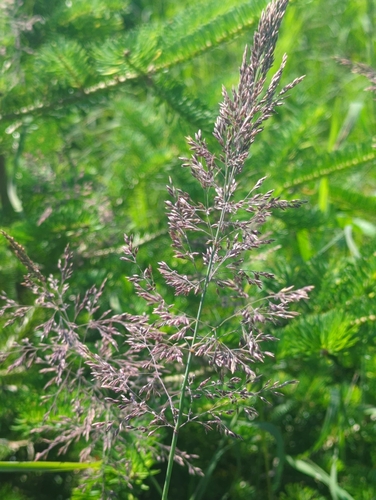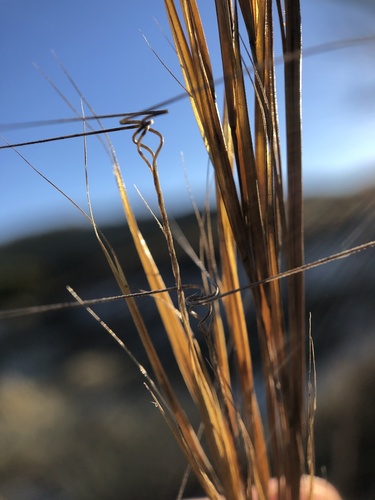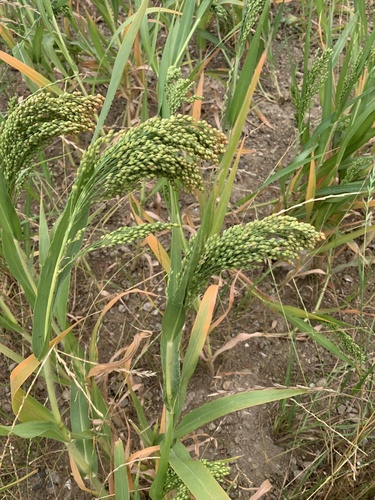
About Panicum miliaceum L.
Panicum miliaceum L. is a grain crop with many common names, including proso millet, broomcorn millet, common millet, hog millet, Kashfi millet, red millet, and white millet. Archaeobotanical evidence indicates this millet was first domesticated approximately 10,000 years before present in Northern China. Its major cultivated areas are Northern China, Himachal Pradesh in India, Nepal, Russia, Ukraine, Belarus, the Middle East, Turkey, Romania, and the Great Plains states of the United States. Around 500,000 acres (200,000 hectares) of this crop are grown each year globally. The crop is well known for two key traits: its extremely short life cycle (some varieties produce grain only 60 days after planting), and its low water requirements, producing grain more efficiently per unit of moisture than any other tested grain species. The name "proso millet" originates from the pan-Slavic general and generic term for millet, used in Serbo-Croatian, Czech, Polish, and Russian. Proso millet belongs to the grass subfamily Panicoideae, and is a relative of foxtail millet, pearl millet, maize, and sorghum. All of these related species use C4 photosynthesis, but most of them use the NADP-ME pathway as their primary carbon shuttle. In contrast, proso millet uses the NAD-ME pathway as its primary C4 carbon shuttle. As of 2015, the total cultivated area of proso millet in the United States was 204,366 hectares (505,000 acres), with most production located in the Great Plains states. The top three producing U.S. states in 2015 were Colorado (109,265 hectares / 270,000 acres), Nebraska (42,492 hectares / 105,000 acres), and South Dakota (28,328 hectares / 70,000 acres). While proso millet was historically grown for animal and bird seed, it has developed a market as an organic gluten-free grain as of 2020. It is one of the few millet types that is not cultivated in Africa. Weedy forms of proso millet grow across central Asia, in a broad area extending east from the Caspian Sea to Xinjiang and Mongolia. These weedy forms may be the wild progenitor of domesticated proso millet, or they may be feral plants that escaped from domesticated cultivation. In the United States, weedy proso millet descended from feral escapes from cultivation is now common, which suggests modern proso millet cultivars still retain the ability to revert to a weedy form, similar to the pattern observed in weedy rice. The earliest current archaeological evidence for domesticated proso millet comes from the Cishan site in semiarid northeast China, dating to around 8,000 BCE. Because early proso millet varieties had such a short life cycle, as little as 45 days from planting to harvest, researchers think they allowed seminomadic tribes to first adopt agriculture, forming a bridge between hunter-gatherer lifestyles and early agricultural civilizations. Charred archaeological grains of common millet have been found at several Neolithic sites in Europe and Transcaucasia, but radiocarbon dates obtained directly from the grains via the AMS method show that the species only arrived in this region in the 2nd millennium BCE. By around 1700 BCE, broomcorn millet was present north of the Black Sea; it reached central Europe by 1450 BCE, and northern Europe by 1200 BCE. Proso millet is a relatively low-demand crop, and no significant diseases are known to affect it. For this reason, it is often used in European organic farming systems. In the United States, it is commonly used as an intercrop, which helps avoid summer fallow and enables continuous crop rotation. Its shallow superficial root system and resistance to atrazine residue make it well suited as an intercrop between two water- and pesticide-intensive crops. Stubble from the previous crop allows more heat to penetrate the soil, leading to faster and earlier growth of millet. While millet occupies the field, its superficial root system lets the soil replenish its water content for the next crop. Subsequent crops, such as winter wheat, can in turn benefit from the millet stubble, which acts as a snow accumulator. P. miliaceum is commonly divided into five races: miliaceum, patentissimum, contractum, compactum, and ovatum.