About Panicum hemitomon Schult.
Panicum hemitomon Schult. is a grass species with the common name maidencane. It is native to North America, occurring along the southeastern coastline from New Jersey to Texas, and it is also present in South America.
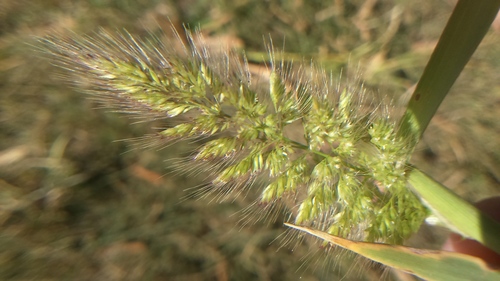
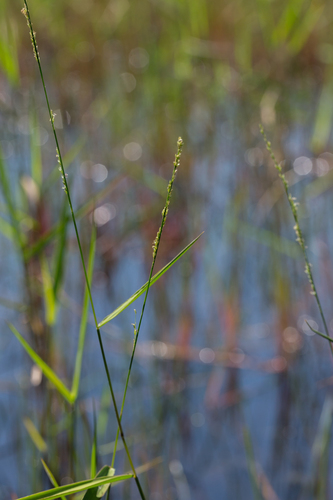
This plant is a rhizomatous perennial grass that can grow stems up to 2 meters in height. It is aquatic or semi-aquatic, growing in water or wet soils. It spreads via rhizomes to form large colonies. Its canelike roots are filled with air and form a mass up to 46 centimeters wide. Stems may be erect or spreading; if stem nodes contact a moist substrate, they will root. Broken stems that float away can root in new locations where they land. This species produces both fertile and sterile stems. Its leaves grow up to 35 centimeters long by 1.5 centimeters wide, with tapering tips. The inflorescence is a panicle with upright branches.
This is a common grass in coastal freshwater wetlands. It only grows in freshwater, and does not grow in saltwater or brackish water. It can be found in many types of freshwater wetlands, as well as ditches, disturbed areas, and cultivated areas. It is less sensitive to grazing than many species that grow alongside it, but its growth is reduced by competition from neighboring plants. It is common in the Everglades and other regions of Florida.
It may form large monotypic stands that can be rooted, or float freely to form floating marsh. It forms its densest stands on drier sites within wet habitats, and it can tolerate several months of flooding. Its rhizome network helps stabilize soil and prevent erosion, so some biologists classify it as a keystone species.
This grass sprouts from its rhizome in winter and grows throughout the year, reaching its maximum density in summer and fall. Aboveground plant parts die and break off to form floating mats, after which the rhizome becomes dormant.
Maidencane is good cattle forage, and maidencane-dominated marshes in Florida are used for cattle grazing. It can also be used as hay. It is eaten by deer, and it is utilized by the Florida panther, which lives in these marshes. The American alligator also inhabits maidencane wetlands, and many other animals live in these habitat types.
This plant is considered a weed in some areas, such as cultivated crop fields. It is also considered a nuisance species when it grows very dense, and it may compete with waterfowl food plants. Controlled burns are sometimes conducted to thin this plant.