About Panellus stipticus (Bull.) P.Karst.
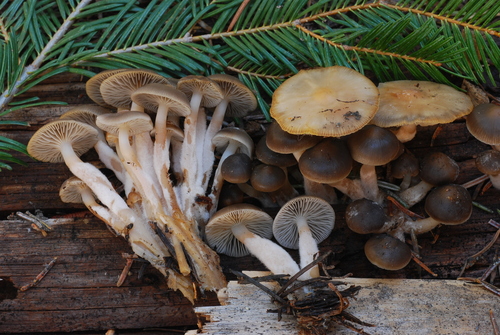
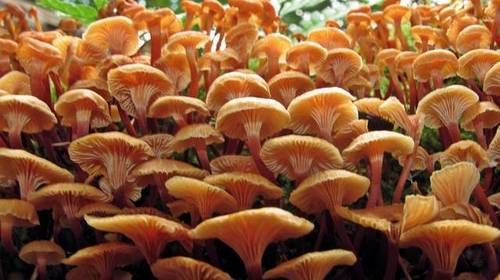
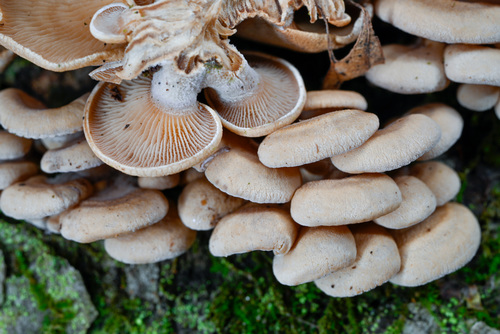
Most of the time, the fungus Panellus stipticus lives unseen as a mass of thread-like vegetative cells called a mycelium, growing inside rotting wood. It only produces its reproductive structures—known as fruit bodies or mushrooms—when environmental conditions for temperature, moisture, and nutrient availability are suitable. The cap of a fruit body is kidney- or clamshell-shaped, ranging from convex to roughly flat, and measures 1.2 to 3.2 cm (0.5 to 1.3 in) by 1.2 to 2.5 cm (0.5 to 1.0 in). The cap edges are scalloped with small rounded teeth and curve slightly inward. The cap surface is dry, marked with block-shaped patterns resembling cracked dried mud, covered in fine small hairs that give it a somewhat woolly texture, and may have several concentric ridges or zones. Fresh fruit bodies range in color from yellowish-orange to buff to cinnamon; when dried, they turn various shades of tan, brown, or clay, and their faded color will typically revive when they are moistened again. On the underside of the cap, the gills are narrow, closely spaced, often forked, colored brownish to buff, and have many interconnecting cross-veins. The cap is supported by a stem that is 0.5 to 2 cm (0.2 to 0.8 in) long by 0.3 to 0.8 cm (0.1 to 0.3 in) thick, attached off-center to the cap at or near the cap’s edge. The dull-white stem is covered in tiny silk-like fibers and narrows at its base where it connects to its growing substrate. Fruit bodies of Panellus stipticus have no distinctive odor. Their flesh is thin, tough, and colored dark yellow-brown to cream. Panellus stipticus is common in the northern temperate regions of Europe, and has also been collected in Australia, New Zealand, Anatolia, Japan, and China. In North America, it is more common in the east than the west; its northern range extends to Alaska, and it has been collected as far south as Costa Rica. It is a saprobic species that causes white rot, a form of wood decay where the fungus secretes enzymes that break down lignin, cellulose, and hemicellulose, leaving the wood with a bleached appearance. Fruit bodies usually grow in tightly overlapping clusters on the sides of hardwood trees, logs, stumps, and fallen branches. While it most often grows on dead wood, it can also grow opportunistically in the wounds of living trees. In North America, its preferred host trees are oak, birch, maple, hickory, pecan, and American hornbeam; in Europe, it is commonly found growing on oak, birch, alder, beech, hazel, chestnut, and ash. It has also been found growing on Erica in North Africa. Though it favors hardwoods, it has been reported growing on loblolly pine and eastern white pine. Fruiting occurs from September through November in Europe, the Canary Islands, and North America, though it can sometimes be found in the spring. Its fruit bodies are long-lasting, so they can be found year-round. It is an early-stage succession fungus, and is not typically recorded in plantations over 20 years old. Its fruit bodies are frequently eaten by slugs, which may act as important agents for dispersing the fungus’s spores. White-tailed deer are also known to consume this fungus. Panellus stipticus has a heterothallic, tetrapolar mating system: each basidiospore grows into a self-sterile mycelium that remains homokaryotic (all cells genetically identical) indefinitely when grown alone. Researchers have paired collections of P. stipticus from Japan and Eastern North America, and later from New Zealand and Russia. Though these separated allopatric populations differ in bioluminescence and taste, results showed they belong to a single universal intercompatibility group across these geographical regions. In a 2001 study, Jin and colleagues also paired geographically representative collections of the fungus, and observed reduced ability to cross between Northern Hemisphere and Oceanian collections, as well as between and within Oceanian collections. Panellus stipticus is considered too small and bitter to be edible, but is classified as nonpoisonous. Its taste has been described as acidic, acrid, or astringent. A 1992 study found that the taste of the fruit bodies varies across the species’ geographic range. Specimens from eastern North America have a mildly acrid taste that develops slowly, and causes uncomfortable drying in the mouth. In contrast, specimens from Japan, New Zealand, and Russia produce no sensation in the mouth, but cause significant constriction and a nauseating taste in the throat. The fruit bodies have been reported to be used in traditional Chinese medicine as a styptic to stop bleeding, and also as a violent purgative.