About Panellus pusillus (Pers. ex Lév.) Burds. & O.K.Mill.
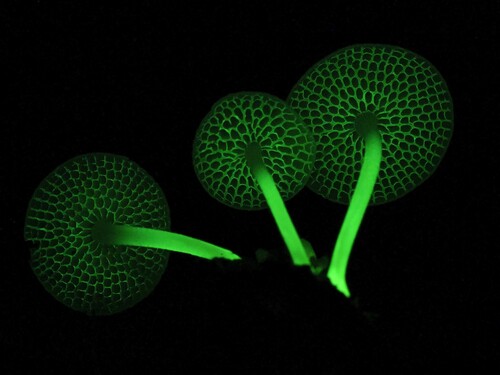
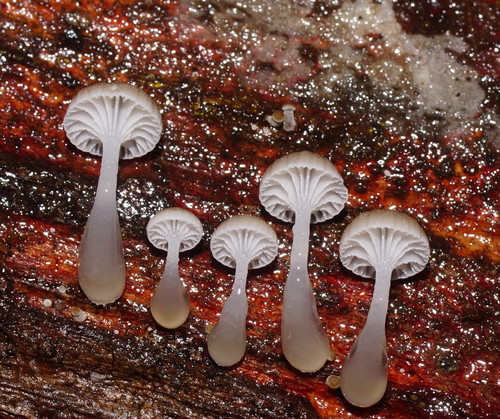
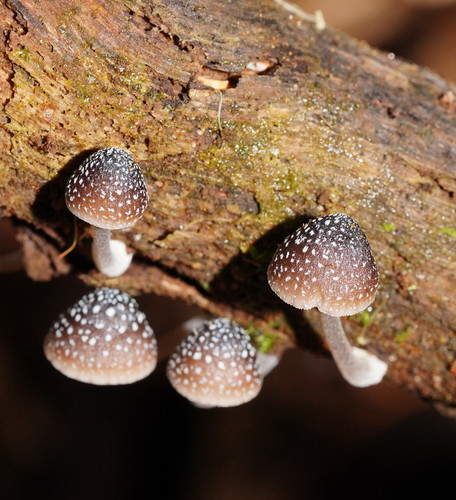
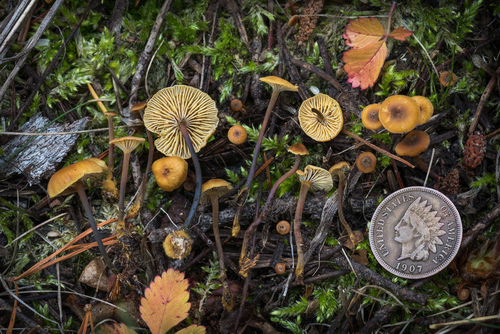
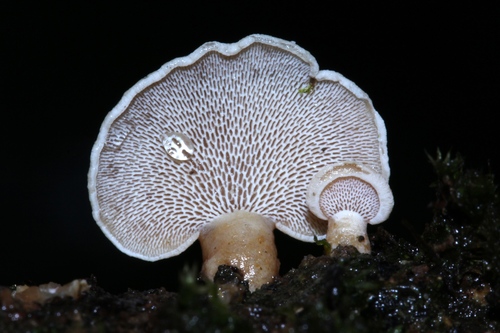
Panellus pusillus is a very small mushroom that is easy to overlook during the day. The widest recorded cap reaches 16 mm across. The stipe (stem supporting the cap) grows up to 6 mm long, 1–2 mm thick, with a base that either enlarges downward or is nearly equal in width. It is finely pubescent, shares the same color as the cap, and can attach eccentrically or laterally to the cap. The cap itself is convex, and shaped semicircular, kidney-shaped, or fan-shaped; this paddle-like shape inspired its common reference description. The cap's upper surface is white to whitish when young, and soon becomes pinkish buff to pale salmon. The surface can be moist or dry, glabrous or finely pubescent, smooth or finely wrinkled, and sometimes bears one or two very shallow concentric furrows. The fertile (spore-producing) surface ranges in color from whitish to pale pinkish buff. The cap margin is incurved, and sometimes sulcate or splits. The pores on the fertile surface are angular, somewhat radially aligned, with 2–5 pores per mm, and the pore tubes grow up to 1 mm deep. The flesh is up to 2 mm thick, firm, white, and has no distinctive odor or taste. One source reports Panellus pusillus is toxic in North Mexico, though few studies have investigated its potential toxicity. Panellus pusillus has been recorded on almost every continent except Africa and Antarctica. It is distributed most commonly in Florida, a region with high humidity, where it often grows in dense overlapping groups on decaying broadleaf plant material in shade. It prefers growing in tropical and subtropical regions. It generally favors hardwoods, but has been reported growing on rotten bamboo culms, eucalyptus, and even pine. It is a saprobic species that causes white rot, a form of wood decay where the fungus secretes enzymes that break down lignin, cellulose, and hemicellulose, resulting in bleached-looking wood.