About Pandorea pandorana (Andrews) Steenis
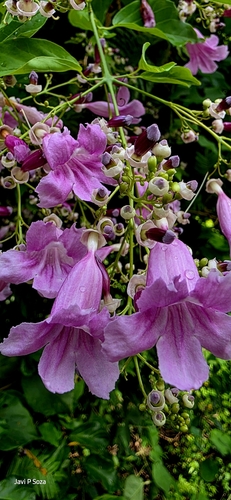
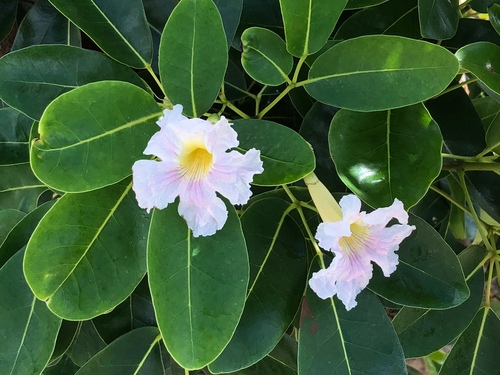
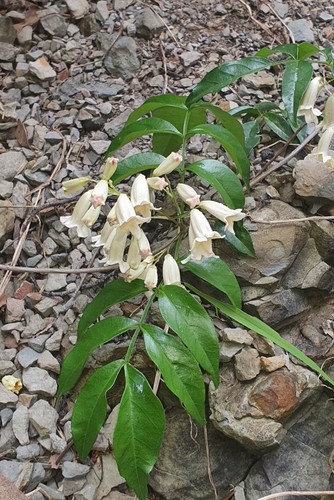
Pandorea pandorana is a glabrous woody climber or scrambler that sometimes reaches 6 m (20 ft) or more in height. Its leaves are arranged in opposite pairs and are pinnate. Leaves on juvenile plants are 20–80 mm (0.79–3.15 in) long, with eight to seventeen wavy-edged leaflets. Adult leaves mostly have three to nine egg-shaped leaflets, borne on a 10–45 mm (0.39–1.77 in) long petiole. Leaflets are 25–80 mm (0.98–3.15 in) long and 5–30 mm (0.20–1.18 in) wide, growing on 1–2 mm (0.039–0.079 in) long petiolules. Flowers are arranged in clusters up to 220 mm (8.7 in) long, containing several to many thyrses. Individual flowers are pendent, tubular or funnel-shaped, each growing on a 2–8 mm (0.079–0.315 in) long pedicel, and are white to cream-colored with purple markings. Sepals are 3–5 mm (0.12–0.20 in) long, joined at the base, with lobes roughly 1 mm (0.039 in) long. The petal tube is 10–25 mm (0.39–0.98 in) long; its tubular section is more or less straight, 5–10 mm (0.20–0.39 in) in diameter, and bearded on the inside, while the lobes are 3–6 mm (0.12–0.24 in) long. Flowering occurs from June to December, and is followed in summer by oblong capsules 10–20 mm (0.39–0.79 in) long and 4–6 mm (0.16–0.24 in) wide that hold a large number of winged seeds. This is a highly variable species. It is found across continental Australia in every state, and also grows in Indonesia, Papua New Guinea, the Solomon Islands, New Caledonia, Vanuatu, and Flinders Island in Bass Strait; it does not occur on mainland Tasmania. In New Zealand, the species has become naturalized in disturbed native vegetation near cultivated parks and gardens. It grows in a wide range of habitats, including rainforest, dry sclerophyll forest, dry scrub, and rocky outcrops in arid regions, and can grow in both clay and sand-based soils. Indigenous Australians of the Central and Western Deserts considered the highly flexible wood of Pandorea pandorana the most sought-after material for woomera-cast spears. Its versatility allowed short pieces to be spliced together when longer pieces could not be found. Due to its cultural significance, a group of mythological women with slender, flexible bodies were named after this species. Pandorea pandorana was first cultivated in England in 1793 by Lee and Kennedy at their Hammersmith nursery, and first flowered in cultivation by 1805. Plant material was also sent to the garden of the Château de Malmaison under the direction of Joséphine de Beauharnais. Its attractive floral display makes it a popular, widely grown garden plant. It is an evergreen, half-hardy twining plant (hardy to about minus 5 °C once established) with attractive foliage; this is especially true for young plants, which have very finely cut, somewhat fern-like foliage. It is suitable for both indoor and outdoor planting. Pruning is required to control this fast-growing plant, which can overwhelm other plants in a small garden. The species prefers full sun to partial shade, and it has been argued that more sun exposure leads to more blooms. It can be propagated from fresh seed, layering, or semi-hardwood tip cuttings. The Australian Nursery and Garden Industry has promoted P. pandorana as a native alternative to the invasive garden climber Black-eyed Susan (Thunbergia alata).