About Panax trifolius L.
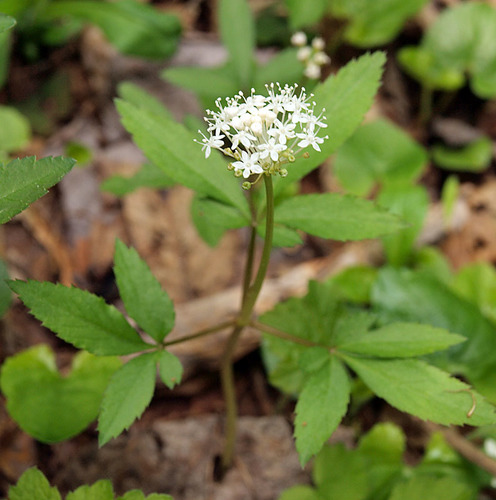
Panax trifolius L., also called dwarf ginseng, has a knobby, fleshy root that resembles a potato. The plant reaches 4 to 8 inches in height. Its tiny flowers are about 2mm wide, radially symmetrical, and grow in spherical clusters. Flowers can be white or pink; each has five petals that start white and fade to pink as the fruit ripens to a yellow color. A single singular stem bears a whorl of three or more leaves at its node. Each leaf holds three to five leaflets, with the middle leaflet being the largest. All leaflets are 2.5 to 3.8 centimeters long and have rigid edges. Floral structures including stamens, petals, sepals, and tepals number five each, and are separate rather than fused. The plant’s rigid seeds are 2.5mm to 3.5mm long, white, and shed their seed coat each fall before germination. Each of its hermaphroditic flowers has three carpellate ovaries, each producing one seed, which results in a slow seed dispersal rate. Panax trifolius grows in undisturbed mesic forests, or on the banks of small streams and rivers. It grows abundantly in moist, rich soil on flat ground, in full or partial shade. It can be found in woodlands or damp clearings within the eastern deciduous forests of North America. Its distribution ranges from Ontario, Canada east to Nova Scotia, south to Georgia, and northwest to Kentucky, Indiana, and Minnesota. It has adapted to a short growing season, making it tolerant of colder climates. There is very little research on the medicinal uses of this plant, but it was historically used by Native American tribes. The whole plant could be made into a tea, while the root could be eaten or chewed. Tea made from the plant was used to treat colic, indigestion, gout, and hives. The root, eaten raw or boiled, was used to treat headaches, fainting, and shortness of breath.