About Palmeria scandens F.Muell.
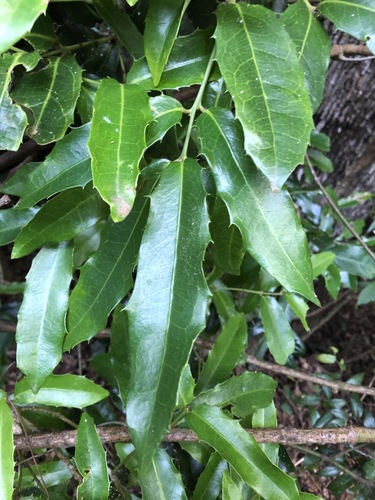
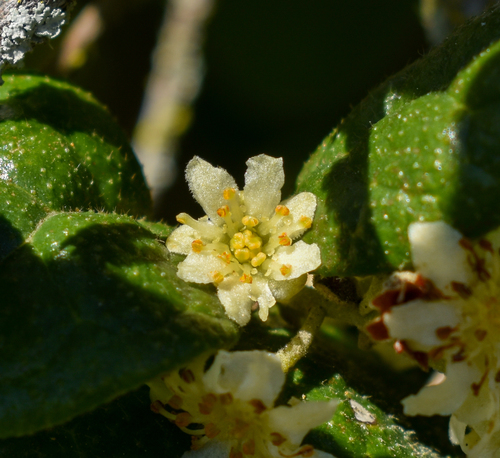
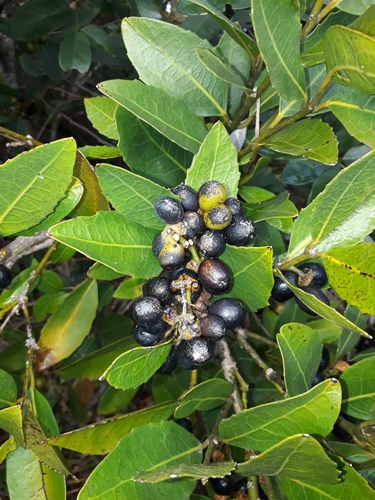
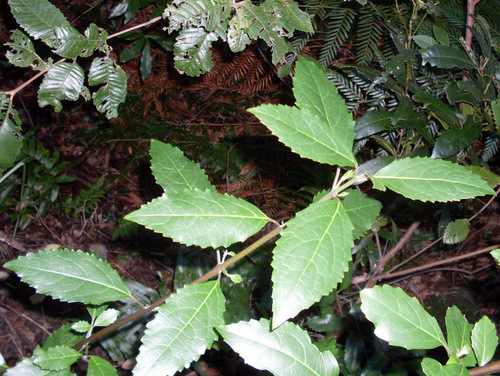
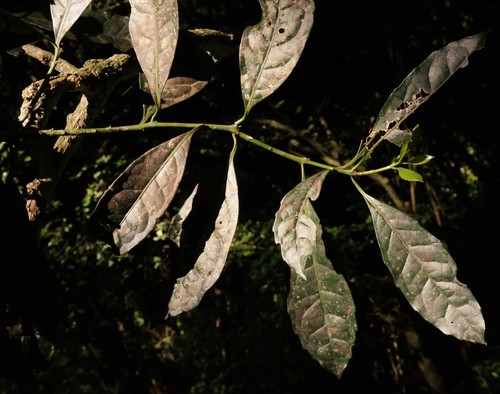
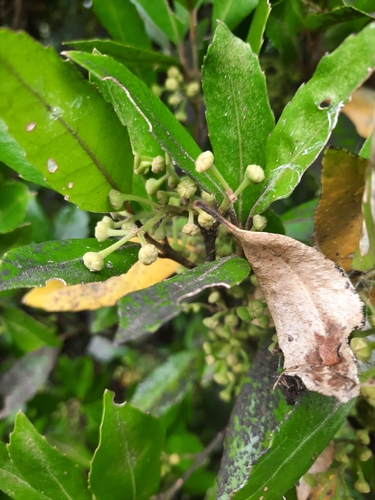
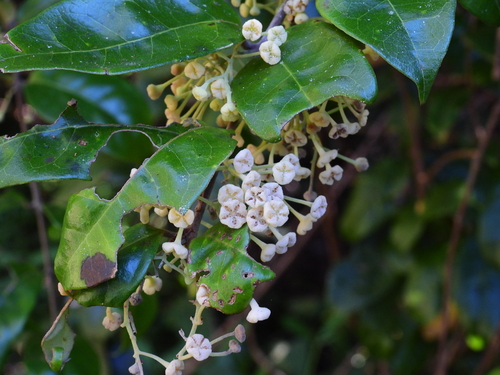
Palmeria scandens, commonly known as anchor vine, is a tall woody climbing plant. Its stems are covered in star-shaped hairs. Leaves are usually elliptic to oblong, measuring 45–190 mm (1.8–7.5 in) long and 20–90 mm (0.79–3.54 in) wide, and grow on a 5–12 mm (0.20–0.47 in) long petiole. Leaf edges are sometimes notched, and soft hairs cover both leaf surfaces, often growing densely on the lower surface. This species is dioecious, meaning male and female flowers grow on separate individual plants, and all flowers have 4 or 5 tepals. Male flowers grow in clusters 30–55 mm (1.2–2.2 in) long containing 7 to 15 flowers. Each male flower is 3–8 mm (0.12–0.31 in) in diameter, grows on a 4–8 mm (0.16–0.31 in) long pedicel, and typically has 30 to 40 stamens around 1.5 mm (0.059 in) long. Female flowers grow in clusters around 20 mm (0.79 in) long containing 5 to 9 flowers. Each female flower is 2–3 mm (0.079–0.118 in) in diameter, grows on a 4–5 mm (0.16–0.20 in) long pedicel, and has around 10 carpels. Flowering takes place from May to September. The fruit is green on the outside when immature, and splits open to reveal a pinkish receptacle that holds 3 to 7 more or less spherical drupes, which are black or red. This vine is widespread in rainforest, ranging from Batemans Bay in southeast New South Wales to the McIlwraith Range on Cape York Peninsula, Queensland, at altitudes between near sea level and 1,500 m (4,900 ft). It also grows in New Guinea.