About Palicourea tomentosa (Aubl.) Borhidi
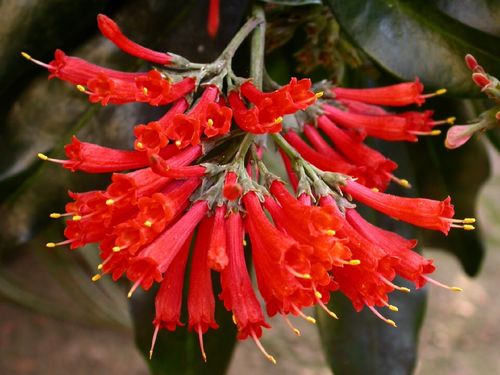
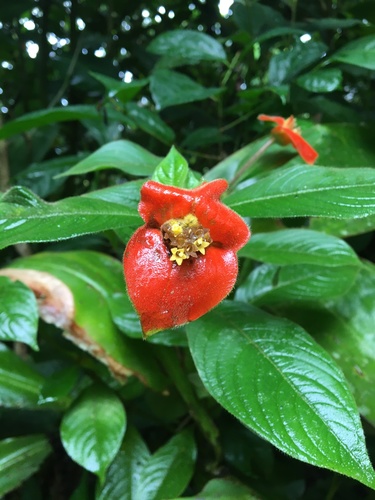
Palicourea tomentosa (Aubl.) Borhidi is a plant species in the Rubiaceae family, and it has many synonyms, including Psychotria poeppigiana. It has one common name, sore-mouth bush, though this name is not frequently used. This species has a wide distribution across tropical Americas: its range extends from the Mexican states of Chiapas, Oaxaca, Tabasco, and Veracruz all the way to the far northern part of Argentina. It does not grow on the Pacific side of the American Cordillera, so it is not found in El Salvador or Chile, and it is also likely absent from Uruguay and Paraguay. Palicourea tomentosa is a large shrub. Its inflorescences grow upright or semi-erect, and are surrounded by large, bright red bracts that attract pollinators. The actual flowers of the plant are not showy; they have small yellow petals and sepals that form a narrow corollar tube. The main pollinators of this species are hummingbirds, particularly small hermit hummingbirds in the subfamily Phaethornithinae: these include the black-throated hermit (Phaethornis atrimentalis), straight-billed hermit (P. bourcieri) and reddish hermit (P. ruber). These hummingbirds do not insert their bills deeply into the small flowers of this plant, so both curved-billed and straight-billed species can act as pollinators for the sore-mouth bush. The Ka'apor people of Maranhão, Brazil, use the flowers of Palicourea tomentosa as a hunting fetish, a magical talisman meant to improve hunting success. Tulane University anthropologist and historical ecologist William Balée describes this practice: "... flowers of Psychotria poeppigiana [...] are wrapped in a piece of cloth and affixed to a dog's collar so that it may more easily find the enormous, highly desirable, and decidedly uncommon tapir". Palicourea tomentosa has a number of uses in folk medicine. It is widely used as a painkiller, in addition to having several more specialized medicinal applications. The Tiriyó people of Suriname crush and boil the plant, and use the resulting decoction to treat headaches, sprains, rheumatism, muscular pains and bruises. The Wayana people, also from Suriname, grind the plant's bark and apply it raw to a specific rash they call poispoisi. The plant's bracts are crushed to release their sap, which is then placed into the ear canal to relieve earaches. A decoction made from boiling the whole inflorescence is thought to have antitussive properties, and is used as a remedy for whooping cough and more generally to treat respiratory tract infections. Decoctions made from the leaves of the subspecies barcellana are also used for these purposes. Palicourea tomentosa contains dimethyltryptamine, but based on how native peoples use the plant, it probably does not contain enough of the compound to produce strong psychedelic effects.