About Palicourea elata (Sw.) Borhidi
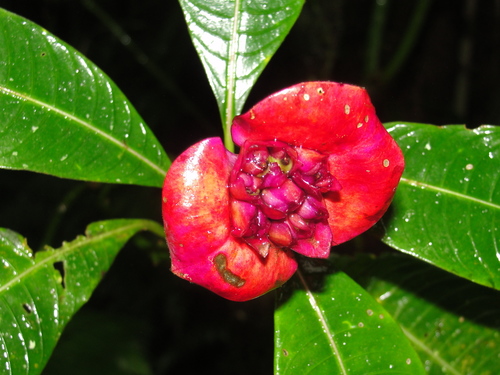
Palicourea elata (Sw.) Borhidi is a shrub in the Rubiaceae family, which is also commonly called the coffee, madder, or bedstraw family. Members of the Rubiaceae family are recognizable by their simple, opposite leaves with interpetiolar stipules, and species in this family can grow as terrestrial trees, herbs, lianas, or shrubs like P. elata. This plant typically grows in the understory of rainforests. It usually reaches 1 to 3 meters (3.3 to 9.8 feet) in height, and may occasionally grow as tall as 4 meters (13 feet). The plant’s morphology varies considerably, directly affected by the community structure of neighboring plants and the amount of light it can access. These factors, along with the general resources available to the plant, impact the biomechanics, allometry, and branching of P. elata, which in turn affect its final height and leaf count. The most distinctive features of P. elata are its red bracts, which are modified leaves. Before the plant’s flowers bloom, the bracts resemble a pair of human lips. The small, star-shaped flowers of P. elata bloom from December to March. P. elata belongs to the genus Palicourea, and like many species in this genus, it produces no detectable scent. Because it has no scent to attract pollinators, the plant relies entirely on its distinctive shape to draw pollinators such as butterflies and hummingbirds. After pollination and fertilization, P. elata produces small black or dark blue berries. These berries are dispersed by birds, which is a common seed dispersal mechanism for plants in the Palicourea genus. The bark and leaves of P. elata are used in folk medicine to treat earaches, coughs, and skin irritation or rashes. The Guna people native to Panama and Colombia have traditionally used this flower to treat dyspnea. In Nicaraguan communities, the plant is used to alleviate side effects from snake bites, and all parts of the plant are used for this purpose. For medicinal uses, the selected plant parts are prepared either as a decoction taken orally, or as a poultice applied topically. As noted earlier, the plant produces a psychedelic effect that could potentially have medical applications, but it is mostly used in ceremonies by native communities. The plant has been found to have both antimicrobial and anti-inflammatory properties. It is typically harvested from secondary growth forests. Very little research has been conducted on Palicourea elata overall, and even less medical research exists. Most available information about the plant comes from anecdotal reports from native populations, which have been tested for validity in some cases, such as testing for the reported antimicrobial and anti-inflammatory properties.