About Palafoxia rosea (Bush) Cory
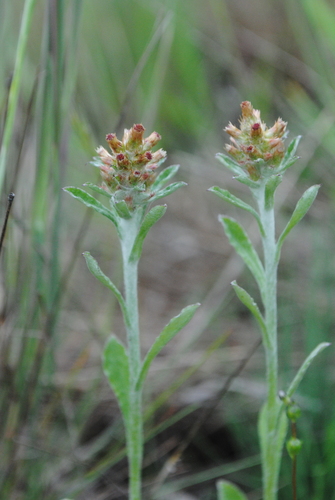
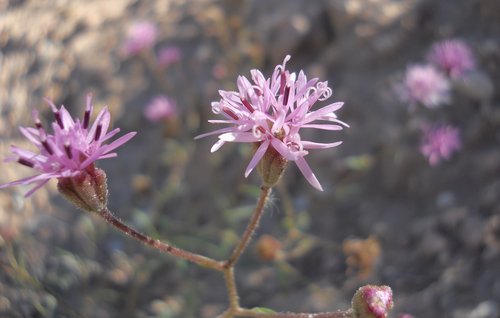
Palafoxia rosea (Bush) Cory has an erect, slender stem that reaches 30 to 60 centimetres (12 to 24 inches) in height. The stem branches in its lower half, bears sparse leaves, and is covered in glands and hairs on its upper sections. Its glabrous, glandular leaves are lanceolate, arranged alternately, 3 to 20 millimetres (1/8 to 3/4 inch) wide, and 4 to 7.5 centimetres (1 5/8 to 3 inches) long. A small number of flower heads grow at the tips of the plant's upper branches. The ray florets range in color from reddish to pink, and each has three narrow lobes. These florets are subtended by involucral bracts. The seed-like fruit of the plant is narrow, and bears a pappus made of several pointed scales, a feature that gives the related species P. arida the common name 'Spanish Needles'. Palafoxia rosea plants self-sow very readily. Palafoxia species are drought-tolerant annual herbs native to the United States and Mexico. They grow in sandy plains, dunes, deserts including the Mojave Desert and Sonoran Desert, and rangeland. The species P. callosa is naturalized in Hawaii. Palafoxia plants are attractive to bees, butterflies, and birds. They act as food plants for the larvae of some Lepidoptera species, including Schinia niveicosta, which feeds exclusively on the related species P. linearis. Palafoxia rosea, commonly called rosy palafox, has been used in folk medicine to treat fever, nausea, and chills.