About Pagophilus groenlandicus (Erxleben, 1777)
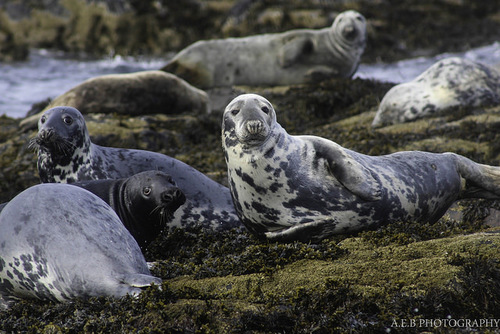
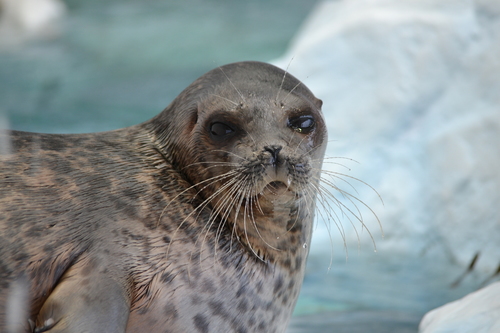
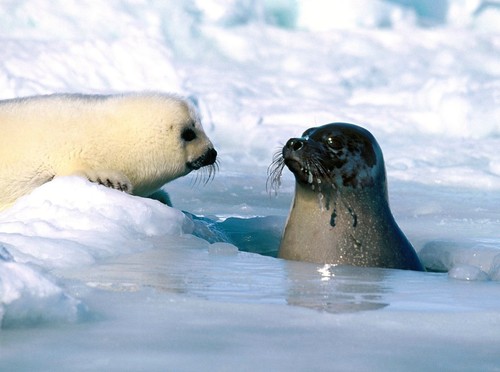
Mature harp seals (Pagophilus groenlandicus) have solid black eyes and silver-grey fur covering their bodies, with distinct black harp or wishbone-shaped markings on their dorsal side, which gives the species its common name. Adults reach 1.7 to 2.0 m (5 ft 7 in to 6 ft 7 in) in length and weigh 115 to 140 kg (254 to 309 lb), with very little sexual dimorphism in size—males are only slightly larger than females. Harp seal pups have a white coat for their first 2–3 weeks, until their first moult, when it is replaced by a silver to grey coat marked with black dots. Pups develop their characteristic adult markings as they approach sexual maturity: the transition to the full harp pattern is usually abrupt in males, while it may be gradual and take multiple years in females. Some females never lose all their spots or fully develop the harp pattern.
The global total population of harp seals is estimated at around 4.5 million individuals. Because harp seals depend on pack ice for breeding, their range is limited to regions where seasonal pack ice forms. There are three distinct allopatric, non-interbreeding stocks, with the largest being the western North Atlantic population found off eastern Canada. This western stock is split into two separate herds based on breeding location: the Front herd breeds off the coast of Labrador and Newfoundland, and the Gulf herd breeds near the Magdalen Islands in the central Gulf of St. Lawrence. The second stock breeds on the "West Ice" off eastern Greenland, and the third stock breeds on the "East Ice" in the White Sea, off the north coast of Russia below the Barents Sea. Breeding occurs between mid-February and April, with slight timing differences between each stock. Some individuals from the Greenland Sea sub-population have been recorded foraging in the Barents Sea alongside the White Sea sub-population during late summer and fall. As of 2017, pup production in the traditional southern Gulf of St. Lawrence pupping area was greatly reduced: an estimated 18,300 pups (95% confidence interval (CI), 15,400–21,200, rounded to the nearest hundred) were born in the southern Gulf, and another 13,600 (95% CI, 7,700–19,500) were born in the northern Gulf. An estimated 714,600 pups (95% CI, 538,800–890,400) were born off the northeastern coast of Newfoundland (the Front), accounting for 96% of all global harp seal pupping that year. The combined total estimated pup production across all areas was 746,500 (95% CI, 570,300–922,700). Two subspecies of Pagophilus groenlandicus are currently recognised.
Harp seals breed on fast ice and are thought to have a promiscuous mating system. Breeding occurs between mid-February and April. Courtship begins on the ice, but mating typically takes place in the water. Courtship activity peaks in mid-March, with males performing underwater displays that use bubbles, vocalizations, and paw movements to attract females, while females remain on the ice and will only mate underwater. Females reach sexual maturity between five and six years of age, and can give birth to one pup annually after maturing, usually in late February. The total gestation period is around 11.5 months, with an active fetal development phase of 8 months; the fertilized embryo remains suspended in the uterus for up to three months before implantation, to delay birth until sufficient pack ice is available. While twin births have been recorded, single births are vastly more common.
Harp seal births are very rapid, with recorded durations as short as 15 seconds. To cope with the sudden temperature change and underdeveloped blubber layer after birth, pups rely on solar heating and behavioral adjustments such as shivering or seeking warmth in shade or even water. Newborn pups average 11 kilograms (24 lb) in weight and measure 80–85 cm (31–33 in) in length. After birth, a mother only nurses her own pup. She does not hunt during the approximately 12-day nursing period, and loses up to 3 kilograms (6.6 lb) per day. Harp seal milk initially contains 25% fat, which increases to 40% by weaning as the mother fasts. Pups gain over 2.2 kilograms (4.9 lb) per day while nursing, quickly building up their blubber layer. During nursing, the juvenile greycoat grows in beneath the white neonatal coat, and pups reach a weight of 36 kg (79 lb) by weaning. Weaning is abrupt: the mother quickly transitions from nursing to mating and leaves the pup behind on the ice.
After being abandoned, the pup stays sedentary to conserve body fat. It sheds its white neonatal coat within a few days to reach the "beater" stage—named for the sound the young seal's tail makes when it learns to swim. Pups begin feeding at 4 weeks of age, but still rely on stored internal energy, drawing first on energy stored in the body core rather than blubber. This fasting period can reduce the pup's total body weight by up to 50%. Up to 30% of pups die within their first year, in part due to their early immobility on land. During this period, ice begins to melt, leaving young seals vulnerable to predators including polar bears, killer whales, and Greenland sharks. Pups moult a second time around 13–14 months old, becoming "bedlamers". Juveniles moult several times to develop a "spotted harp" coat before the full adult harp-marked pelt emerges, which takes several years in males and may never fully emerge in females. Every year, harp seals congregate on ice to moult, give birth, and breed, before migrating to summer feeding grounds. The maximum lifespan of harp seals is over 30 years.