About Paeonia mascula (L.) Mill.
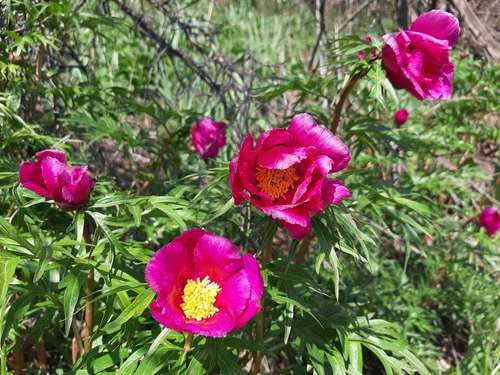
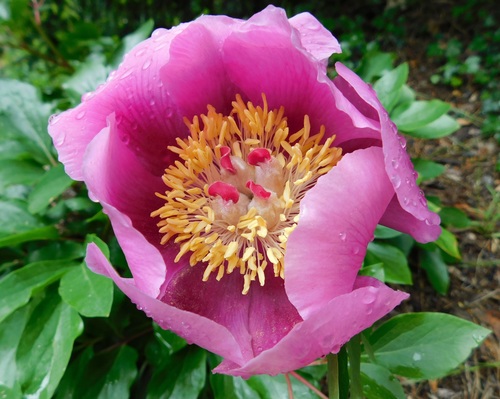
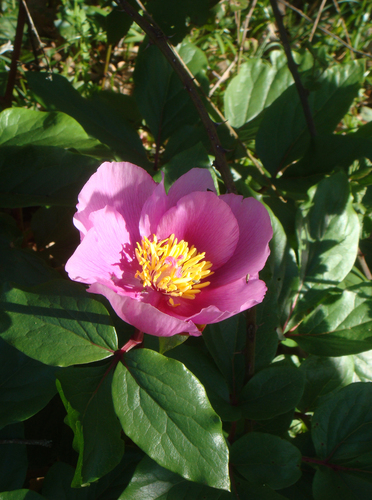
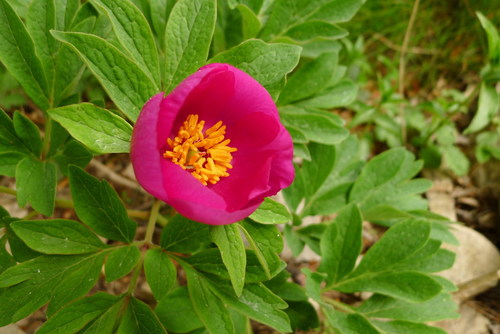
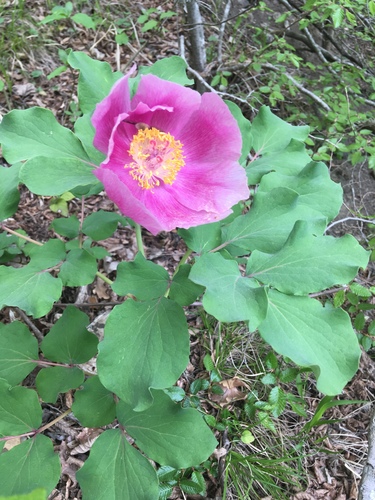
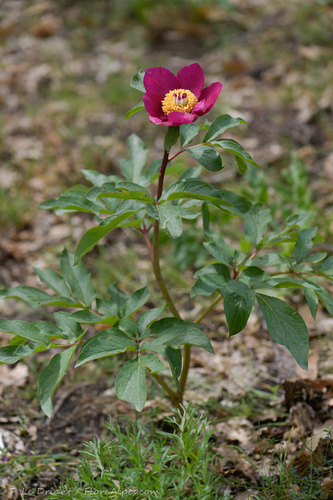
Paeonia mascula (L.) Mill. is a species of peony. It is a herbaceous perennial that grows 0.5–1.5 m (1.6–4.9 ft) tall. Its leaves are divided into three segments, and it produces large red flowers during late spring and early summer. This wild peony is native to Syria, Spain, France, Italy, Croatia, Bosnia and Herzegovina, Serbia, Cyprus, Montenegro, Bulgaria, Greece, Turkey, Iraq, Lebanon and Israel. It has become naturalized on two small islands in the United Kingdom. In its natural environment, Paeonia mascula is at risk due to collection demand from private collectors, and there is a significant trade in wild-harvested P. mascula from Turkey. It grows best in light, sandy soils, though most peonies can grow in heavy clay soil. The wild peony prefers acid and neutral soils, can grow in semi-shade, and tolerates drought. It was introduced to Steep Holm island in the Bristol Channel, possibly by monks. In the 1930s, 37 plants were taken to nearby Flat Holm island by the then-farmer Frank Harris. Many of these plants died during World War II, when the island was occupied and fortified. One remaining plant was reintroduced by the Flat Holm Warden in 1982, and it is protected by fencing near the path to the lighthouse. A small number of plants grown from seed also survive in the island’s farmhouse garden. The roots of P. mascula have been ground into powder and used to treat colds and sore throats.