About Paeonia daurica Andrews
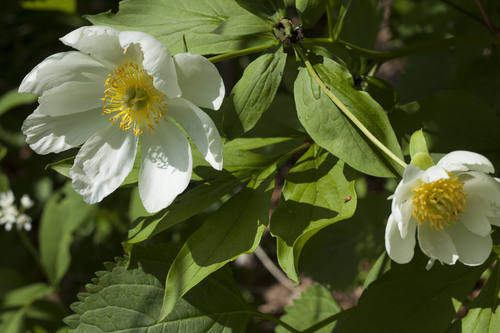
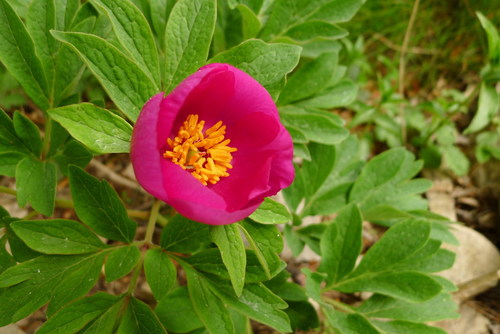
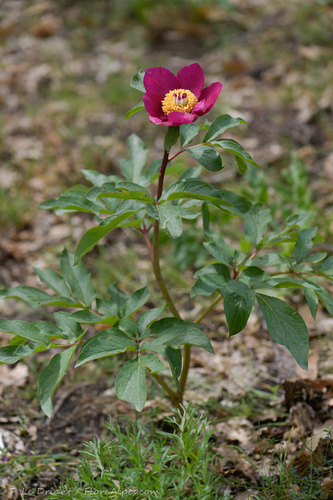
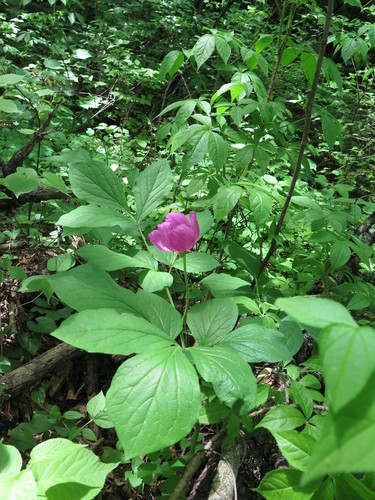
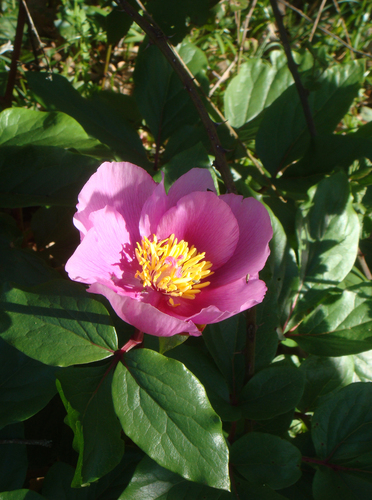
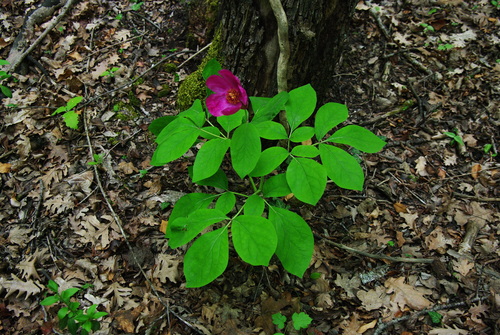
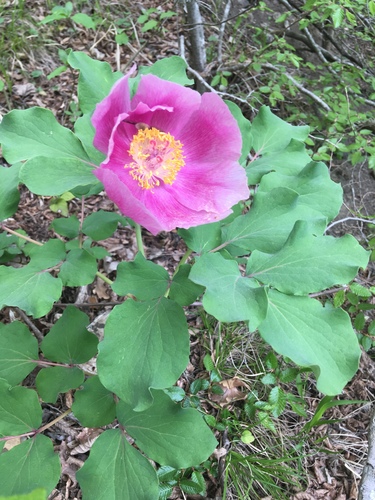
Paeonia daurica Andrews is a perennial herbaceous photosynthetic plant. It emerges above ground in spring and retreats entirely underground in autumn. It grows downward-directed, slender, carrot-shaped roots. Its leaves are arranged alternately along the stems, and have an overall size of 5–11.5 × 8–17 cm. Lower leaves are usually made up of three groups of three leaflets; these leaflets are usually entire, occasionally split in two, and rarely subject to a third round of division that produces a maximum of nineteen leaflets total. Leaflets range from wide to narrowly oval, with their widest point at mid-length or closer to the tip. Leaflet bases are more or less wedge-shaped, sometimes rounded; their margins are entire and occasionally wavy, and their tips are rounded or end in a small or large sharp point. The upper surface of leaves is hairless, while leaf undersides are either hairless or covered in sparse to dense felty hairs. Each hermaphrodite flower is borne individually at the tip of a stem, and is subtended by zero to two leafy bracts. Each flower has two or three green sepals, five to eight petals that can be white, pale yellow, yellow, yellow with a red base blotch, yellow with a reddish margin, pink, red, or purple-red, and many stamens. Stamens have pale, yellow, pink, or purple filaments topped with anthers that hold yellow pollen. At the center of each flower are one to five carpels, which may be hairless or covered in sparse to dense felty hairs. Carpels are almost directly tipped by stigmas, which from a top-down view are mostly curved or S-shaped. Paeonia daurica has a scattered distribution across the Balkans (including Romania, Bulgaria, Serbia, Croatia, Bosnia, Montenegro, Albania, Macedonia, and northern Greece), the Crimea, the Caucasus (including Dagestan and Krasnodar Krai in Russia, Georgia, and Azerbaijan), Turkey’s Kaçkar Mountains, northern Iran’s Alborz Mountains, the Talysh Mountains (west of Guilan province, south of the Caspian Sea), and Lebanon. The nominate subspecies P. daurica subsp. daurica is widespread, does not share a range with other subspecies of P. daurica, and does not grow in the Velebit, Caucasus, or Alborz mountains. P. daurica subsp. coriifolia occurs at elevations below 1000 m in the west and northwest of the Caucasus. It grows in deciduous forests dominated by oak, beech, elm, maple, and ash, or in mixed forests of fir, oak, and beech, and grows on a wide range of limestone, sandstone, and volcanic rock substrates. P. daurica subsp. mlokosewitschii is only found in eastern Georgia, northwestern Azerbaijan, and adjacent areas of Russia, where it grows in deciduous forests of oak, beech, elm, maple, and chestnut. P. daurica subsp. wittmanniana occurs in northwestern Georgia and the upper Mzymta River in adjacent Russia, growing between 1000 and 2300 m in deciduous forests, subalpine meadows, and alpine meadows, and only grows on limestone. P. daurica subsp. macrophylla is restricted to the mountains of southwestern Georgia and northeastern Turkey, growing between 1200 and 2200 m, though it has occasionally been found as low as 800 m. It occurs in deciduous or mixed forests and glades, and shows no preference for any particular soil type. P. daurica subsp. tomentosa grows in the Talysh and Alborz Mountains in southeastern Azerbaijan and northern Iran, occurring between 1100 and 1800 m in deciduous forests and pastures on poor sandstone-derived soils. P. daurica subsp. velebitensis only grows between 900 and 1200 m in the Velebit Mountains (part of the Dinaric Alps) of Croatia. P. daurica has hairless leaves, and does not appear to be adapted to a typical Mediterranean climate, instead being suited to more humid summer conditions. The P. daurica population on Mount Orjen grows in forests containing silver fir, European beech, Turkish hazel, the maples Acer pseudoplatanus and A. intermedium, and ash. This population occurs alongside widespread species such as European spindle, mountain cherry, drooping bittercress, and Turk's cap lily, as well as endemics like the Orjen iris. Several subspecies of P. daurica (subsp. daurica, coriifolia, tomentosa, macrophylla, mlokosewitschii, and wittmanniana) are sold as seed or live plants, and are collected by specialist gardeners. These subspecies are reported to be hardy in western Europe and suitable for general garden conditions, with lowland taxa preferring more or less shady locations. Paeonia daurica subsp. mlokosewitschii has been awarded the Royal Horticultural Society's Award of Garden Merit. Because this subspecies' name is difficult for English speakers to pronounce, it is often affectionately nicknamed 'Molly-the-Witch'. Paeonia daurica is listed as a vulnerable (VU) red book species in Ukraine, and is cultivated in the Crimean nature reserves of Yalta, Karadag, and Cape Martyan. In Crimean Tatar, this species is called patlaq çanaq, which translates to 'broken cup'. This name refers to the shape of the petals, which resemble an elegant broken cup with its pieces still held in place.