About Paeonia brownii Douglas
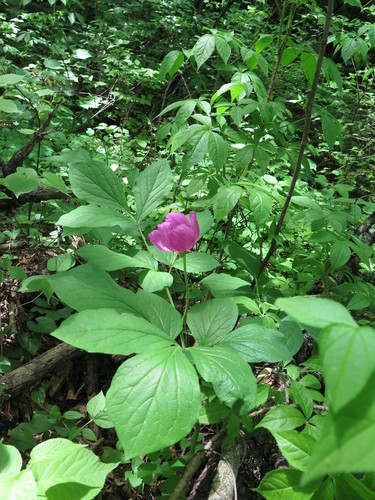
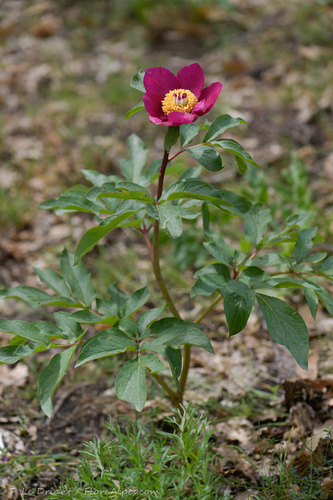
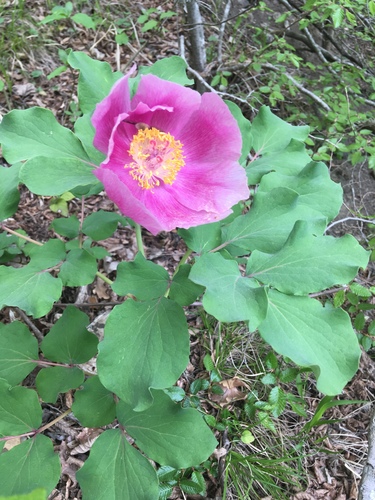
Paeonia brownii Douglas, commonly called Brown's peony, is a glaucous, summer-dormant perennial herb that grows 25–40 cm tall. Each plant can produce up to ten stems growing from a large, fleshy root. The pinkish stems are somewhat decumbent, each bearing five to eight bluish green, hairless, somewhat fleshy, twice compound or deeply incised leaves, which may develop purple-tinged edges when temperatures are low. Leaflet or leaf segment blades are oval to inverted egg-shaped, measuring 3-6 × 2–5 cm, with a distinctly narrowed stalk-like base and a blunt or rounded tip.
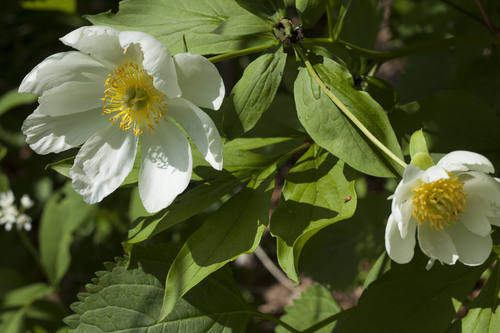
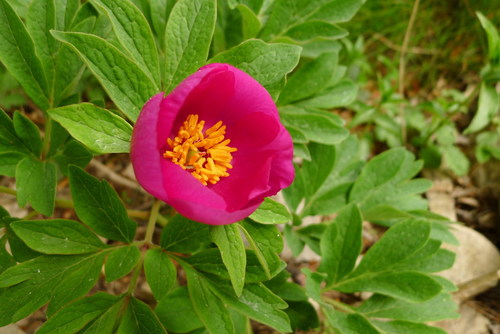
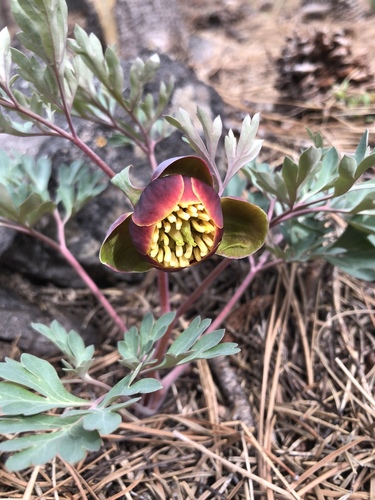
This species produces bisexual flowers that are cup-shaped when open, 2–3 cm across, nodding, and borne individually at the tip of branching stems. Flowers bloom for 9–15 days, with flowering occurring from March to June, mostly from mid-April to mid-May. It has five or six overlapping purplish green, cupped, oval or nearly circular sepals that remain on the plant after flowering. The five to ten circular petals are usually shorter than the sepals, and their color grades from brownish-maroon at the base, through wine red, to greenish or yellowish at the edges. Each flower has 60-100 yellow stamens, with 3–5 mm filaments topped by 2–4 mm anthers. Anthers open in succession from the inside out, shedding yellow pollen starting from the second day after the flower opens.
A disc of around twelve fleshy, cone-shaped, greenish-yellow lobes 2.5-3 mm high surrounds two to six, mostly five, hairless carpels, which are initially yellow-green and turn yellow-red when mature. Each carpel has a short style topped by a curved stigma that forms a ridge. Stigmas are receptive during the first two days the flower is open. After fertilization, carpels mature into leathery ripe follicles 2–4 cm long. About four seeds develop per follicle; seeds are yellowish-brown to black, round to oval, and 6–11 mm in diameter. Like all diploid peonies, Paeonia brownii has ten chromosomes (2n=10).
Brown's peony grows in open dry pine forests such as ponderosa pine stands, sagebrush, mountain brush, and aspen stands, at elevations between 200–3,000 m. Its native habitat has long, cold winters with little to no snow cover and a short growing season. It occurs naturally in northern California, Idaho, Montana, Nevada, Oregon, Utah, Washington and Wyoming in the United States, and is not native to Canada. This species has very specific soil requirements: it will not thrive in excessively wet soil, nor in soil that becomes too dry, and grows best in well-drained locations.
At around 1,050 m altitude in the Blue Mountains, P. brownii grows in an upland prairie on basalt substrate near conifer stands. Alongside a variety of grasses, surrounding associated vegetation includes western monkshood, Hooker's balsamroot, arrowleaf balsamroot, redstem ceanothus, pinkfairies, hairy clematis, dwarf larkspur, parsnipflower buckwheat, fernleaf biscuitroot, nineleaf biscuitroot, sulphur lupine, various beardtongue species, virgate scorpion-weed, sticky cinquefoil, slender cinquefoil, sagebrush buttercup, dwarf rose, Nootka rose, common snowberry, American vetch and northern mule's ears.
Brown's peony avoids summer drought by dying down completely above ground early in summer after flowering, surviving underground using stored nutrients and energy in its thick rootstock. When plant tissue is broken, bruised, or damaged by predation, the plant gives off a strong bitter, unpleasant scent, so it is rarely eaten by animals. Caterpillars of Euxoa ustula, dark grey fishia, and small heliothodes moth have been recorded chewing 1–2 mm holes in the flowers, though these species are more commonly associated with other host plants. Flowers produce the same bitter unpleasant scent more weakly, and the disc lobes secrete sweet nectar with a bitter aftertaste throughout the period that stigmas and anthers are fertile.
According to available pollination studies, the majority of pollinators for this species are wasps (including the common aerial yellowjacket and *Polistes aurifer*) and sweat bees (especially *Lasioglossum* species), alongside hoverflies such as *Criorhina caudata*. A study of an endemic population in Oregon's Blue Mountains by Bernhardt et al. found that the most common pollen vectors were vespid wasp queens, the large flower fly *Criorhina caudata* (Syrphidae), and female *Lasioglossum* species (Halictidae), all of which foraged exclusively for nectar. Although P. brownii produces a significant amount of pollen, its pollinating insects visit the flowers to collect nectar. The study authors noted that it is unlikely vespid wasps co-evolved with the plant, though the wasps benefit P. brownii by preying on moth larvae that feed on it. P. brownii produces hexose-type nectar with glucose as its primary sugar, while Lepidoptera typically prefer flowers that produce sucrose-dominant nectar. The species also uses its distinctive unpleasant odor to increase pollinator selectivity.
Brown's peony is rarely cultivated. It has limited ornamental value due to its small number of small flowers, and it is difficult to grow. It is highly intolerant of excess water during its summer dormancy, so cultivation advice recommends planting it in a garden location with excellent drainage that is sheltered from summer rains. This species tolerates sandy soil.
Native American peoples used the roots of this plant to make a tea for treating lung illnesses. The roots can be eaten for their nutrient content. Indigenous tribal members also used the roots as medicine to cure cough, kidney problems, sexually transmitted infections, pneumonia, nausea, indigestion and tuberculosis.