About Paederia foetida L.
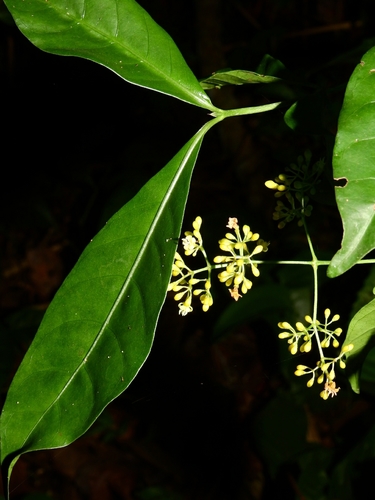
Paederia foetida L. is a plant species whose common names include variations of skunkvine, stinkvine, Hawaiian pilau maile, and Chinese fever vine. It is native to temperate and tropical Asia, and has become naturalized in the Mascarenes, Melanesia, Polynesia, and the Hawaiian Islands; recent studies have also found it in North America. This species is well known for releasing a strong sulphurous odour when its leaves or stems are crushed or bruised. The odour comes from an oil found primarily in the leaves, which contains sulphur compounds, with dimethyl disulphide making up the largest portion of these compounds. The native distribution of P. foetida covers Bangladesh, southern Bhutan, Cambodia, Taiwan, China (Hong Kong, Macau, and the provinces of Anhui, Fujian, Gansu, Guangdong, Guangxi, Hainan, Henan, Hubei, Hunan, Jiangsu, Jiangxi, Shaanxi, Shandong, Shanxi, Sichuan, Xizang, Yunnan, Zhejiang), India (Andhra Pradesh, Arunachal Pradesh, Assam, Manipur, Meghalaya, Mizoram, Nagaland, Odisha, Sikkim, Telangana, northern West Bengal, and the Andaman and Nicobar islands), Indonesia, Japan (Honshu, Kyushu, Shikoku prefectures, and the Ryukyu Islands), Laos, Malaysia, Myanmar, Nepal, the Philippines, Singapore, South Korea, Thailand, and Vietnam. Paederia foetida is sometimes planted as an ornamental, and it is considered useful in folk medicine. It is also used as a culinary spice in some traditional cooking in Northeastern and Eastern India. In Hainanese cuisine, its leaves are ground into flour, mixed with rice to make noodles that are used for a sweet soup.