About Packera obovata (Muhl. ex Willd.) W.A.Weber & Á.Löve
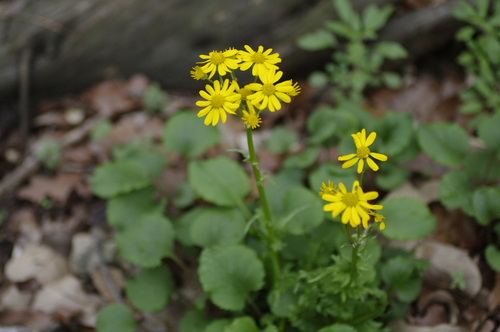
Packera obovata is an erect perennial herb that reaches a maximum height of 2 feet (60 cm). It grows from fibrous roots and produces a basal rosette of leaves that can be up to 1 foot (30 cm) across. The basal leaves are mid-green, hairless, and shaped like circles, ovals, or obovates, with crinkly toothed edges. Leaf stalks are roughly the same length as the leaf blades, colored green or purplish, and usually hairless; some stalks have slight winging and may have a cobwebby texture from fine hairs. The flower stalk may also be cobwebby at its base, and holds two or three alternate pinnatifid leaves with irregular lobes. The top of the stalk forms a flat-headed panicle, and each individual flower head is up to 0.75 inches (2 cm) in diameter. A flower head has a single row of linear-lanceolate green bracts, 8 to 16 yellow ray florets, and a central cluster of orange-yellow disk florets. After flowering, both ray and disk florets produce brown achenes, each topped with a tuft of white hair. Achenes are dispersed by wind, and the plant can also spread vegetatively via stolons or rhizomes.
The native range of P. obovata covers northern Mexico, eastern United States, and southeastern Canada, stretching from Coahuila in the south to Quebec and Ontario in the north. It is most common in the southern half of this native range. Its typical habitats are moist but well-drained calcareous soils, wooded slopes, and rocky areas in shaded or semi-shaded locations.
Flowers of P. obovata bloom in early spring, and are visited by cuckoo bees, halictid bees, andrenid bees, hoverflies, tachinid flies, and various beetle species. Larvae of the northern metalmark butterfly (Calephelis borealis) feed on the plant's leaves, while the white-crossed seed bug (Neacoryphus bicrucis) feeds on its seeds. Like many ragwort species, P. obovata is toxic to many herbivorous mammals, though sheep are more tolerant of it than most other grazing animals. The plant forms colonies by spreading via rhizomes: dense colonies can develop in wet, sunny areas, while colonies are sparser with shorter individual plants in drier, shadier spots.