About Packera glabella (Poir.) C.Jeffrey
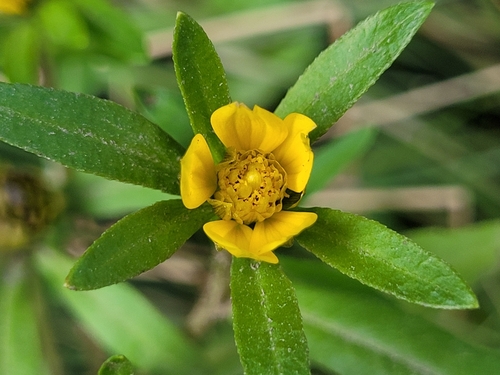
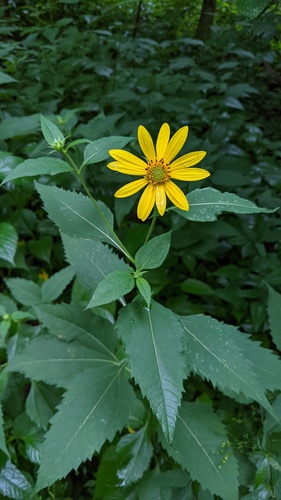
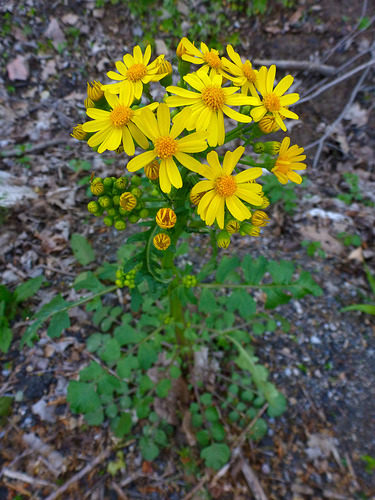
Packera glabella (Poir.) C.Jeffrey is a winter annual weed. It begins growth as a basal rosette in the fall, flowers in winter, and produces seeds in the spring. Its bolting stems are hollow, typically growing to 3 feet (0.91 m) tall. As the stem elongates, it becomes hairless and grooved, and may show red or purple color variations. The basal rosette leaves can grow up to 10 inches (25 cm) long, with deeply lobed pinnate serrations along their margins. Inflorescences usually hold six to twelve yellow ray flowers that resemble dandelions; each individual flower has an inner central disk and an outer ray of five to 15 florets. Its seeds are dispersed by wind, attached to a white, feathery pappus. This species is native to the United States, with an original native range extending from Texas to Florida, north along the Atlantic coast from Florida to Virginia, and west to Nebraska. Herbarium collections record P. glabella present in Illinois as early as 1932. It grows best in moist, low-lying areas, and can bloom in full sun or full shade as long as the site stays wet. Although it is native, P. glabella exhibits high invasiveness, especially in disturbed and agricultural habitats. Its life cycle lets it take advantage of disturbances to natural soil environments. It germinates and forms rosettes in fall, and produces seeds early in spring before many native competitor species break winter dormancy. This seasonal timing advantage, combined with effective wind-driven seed dispersal, lets P. glabella become dominant in no-till crop fields and pastures. The species' increasing spread has been connected to changes in agricultural land management: no-till and reduced-tillage practices create favorable conditions for its germination and overwintering, allowing P. glabella to establish and flower earlier than most competing species. These traits, paired with its preference for disturbed soils, have led to its growing abundance in cropland edges, pastures, and unmanaged fields across the U.S. Midwest. Researchers have classified P. glabella as a "native invasive" — a native species that spreads aggressively in human-modified environments. Recent field surveys show that P. glabella forms persistent seedbanks that can remain viable for multiple years, which increases its ability to rapidly re-establish after disturbance or herbicide treatments. Seed longevity, combined with its early rosette development, lets it exploit gaps in canopy cover during late winter when competing species are still dormant. Climate factors can also increase its invasiveness: wetter springs create ideal conditions for germination and stem bolting, and flood events often deposit bare, nutrient-rich silt where P. glabella seedlings can easily establish. These traits fit a broader documented ecological pattern for disturbance-responsive species, where early spring emergence and flexible germination requirements are strong predictors of invasive behavior. Its ability to form dense stands of yellow flowers that fill entire fields or ditches demonstrates its invasive potential even within its native range. The leaves, flowers, and seeds of P. glabella contain toxic pyrrolizidine alkaloids, which are known to cause liver damage including seneciosis in livestock. Chronic exposure to these compounds can cause loss of appetite and sluggish behavior, and may lead to unsteady movement or neurological impairment in severe cases. The alkaloids act as natural defenses that deter herbivores from feeding on the plant. When P. glabella reaches high infestation levels, pyrrolizidine alkaloids can leach into surrounding soil and water, which may affect soil invertebrate communities and microbial activity. The species is toxic to humans if ingested, causing liver damage, but documented human cases are rare and most impacts affect livestock. Dense stands of P. glabella have been observed to reduce early-season floral diversity by shading small forbs and grasses before they can fully leaf out, creating temporarily simplified plant communities. This early seasonal dominance alters both pollinator visitation patterns and the timing of nectar availability, because dense P. glabella blooms can crowd out the early-spring native species that pollinators depend on. In wetland margins and low-lying agricultural ditches, thick infestations can also slow surface water flow, trap sediment, and shift moisture distribution in ways that favor P. glabella persistence over time. Severe dense infestations can displace native grasses and forbs, reducing overall plant diversity and altering biological community composition in pastures and disturbed land. Since P. glabella thrives in moist, disturbed soils, it often multiplies in no-till crop systems, roadside ditches, and floodplains — all locations with naturally low competition.