About Packera dubia (Spreng.) Trock & Mabb.
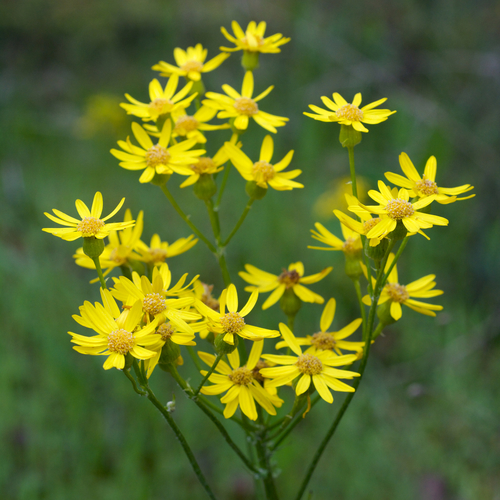
Packera dubia (Spreng.) Trock & Mabb. produces bright yellow flower heads, each with relatively small, narrow ray petals and a large central yellow disk made up of disc florets. Each flower head contains around 10 to 13 ray petals and 50 to 60 disc florets in its center. This species typically does not grow taller than two feet, reaching a mature height between 30 to 60 cm (1 to 2 ft). Thin, hairy basal leaves grow at the base of the plant; these basal leaves are the longest, and leaf size decreases as you move up the stem. Leaf margins of Packera dubia vary, and can be subentire, crenate, or serrate-dentate. Basal leaves and nearby lower leaves grow out from the stem at an angle of approximately 45 degrees. The peduncles bear hairy bracts. After flowering, Packera dubia produces a cypsela: a small, dry one-seeded fruit that develops from an inferior ovary. Packera dubia is distributed across central and southeastern United States. Records from the Ladybird Johnson Wildflower Center list the species as present in Alabama, Arkansas, Delaware, Florida, Georgia, Louisiana, Maryland, Missouri, North Carolina, New Jersey, Oklahoma, South Carolina, Texas, and Virginia. The species is more common in coastal areas than inland regions; for example, it is far more prominent in eastern coastal Maryland than in inland parts of the state. It grows best in moderate climates with four distinct seasons. Per the National Wetland Indicator Status, Packera dubia does not typically prefer wetlands, but it can survive in wetland habitats when necessary. Packera dubia is a perennial species, meaning it lives longer than two years. Its flowering period begins in March and continues through early June, with peak blooming occurring in April and May. While specific pollination data for this species is limited, most members of the Asteraceae family (which Packera dubia belongs to) are pollinated by insects. Species in this family generally use secondary pollination to push pollen onto hairs, where it becomes easily accessible to a wide range of pollinators. Many species in the family can also self-pollinate if outcrossing fails. Morphological variation across the species' range makes Packera dubia difficult to identify at times. A study by Fleming found that plants from the Piedmont and Mid-Atlantic Regions had more leaf and stem hairs, and generally larger basal leaves, while plants from the warmer, more coastal Atlantic Coastal Plain and Gulf Coastal Plain had lower hair density and smaller, narrower leaves. A 2013 study noted that Packera dubia produces different types of seeds as an adaptation to survive in disturbed environments. While all seeds of this species look very similar, inner seeds are heavier and germinate more quickly, while peripheral seeds on the plant are lighter and germinate more slowly. This variation in germination speed improves the chance that at least some plants will survive and persist under unpredictable environmental conditions. The moth species Phyllocnistis insignis feeds on the leaves of Packera dubia. Many species in the genus Packera and the closely related genus Senecio are toxic to a wide range of species because they contain pyrrolizidine alkaloids, but there has been little specific research into the toxicity of Packera dubia itself. Overall, Packera dubia populations are stable, and the species is considered to be at low risk of extinction.