About Pachypodium namaquanum (Wyley ex Harv.) Welw.
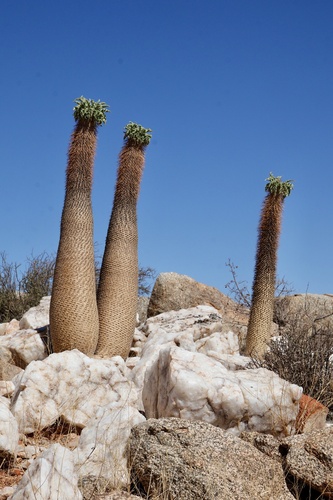
Pachypodium namaquanum (Wyley ex Harv.) Welw. is a single-stemmed succulent. It usually grows 2.5 metres (8.2 ft) tall, and may occasionally reach up to 5 m (16 ft). Its warty trunk is thickest at the base and tapers toward the top, and is densely covered in sharp spines. If the trunk is damaged, it produces side branches that immediately curve back to grow vertically. The very top of the plant usually bends toward the north, a trait similar to the South American cactus Copiapoa cinerea. During the growing season, which falls across the winter months, a crown or tuft of wavy undulate leaves grows at the trunk's apex. This leaf rosette is small, and is completely out of proportion to the overall size of the plant. Tubular, velvet-textured flowers bloom from August to October, and after flowering the plant produces V-shaped twin seedpods. The seedpods split along one side to release plumed seeds that are dispersed by wind. When seen from a distance, the plant looks like a person walking up a slope, which is the origin of its common name halfmens, meaning 'semi-human' in Afrikaans. It is also commonly called elephant's trunk. This succulent is native to the arid, rocky mountains of the Richtersveld in the Northern Cape of South Africa, and also grows in southern Namibia. It occurs in the highest numbers in the Gariep Centre, which hosts the greatest variety of succulents anywhere on Earth. In this region, rain falls mainly in winter, and annual precipitation ranges from 50 to 150 mm. Extremely arid conditions occur in the rain shadows of some mountain ranges here, where annual rainfall may be 15 mm or less. Thick fog that moves inland from the Atlantic coast can add extra precipitation to the area, and summer temperatures here can reach 50 °C.