About Pachypodium lealii Welw.
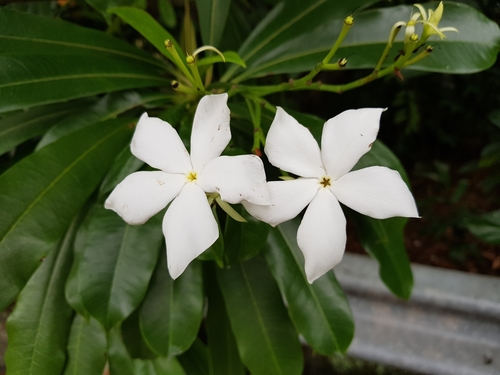
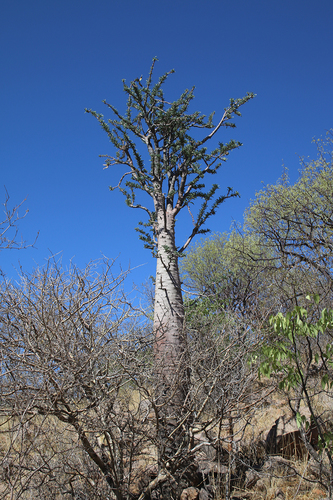
Pachypodium lealii, commonly known as the bottle tree, is a plant species belonging to the genus Pachypodium. Its scientific name honors 19th-century Portuguese geologist Fernando da Costa Leal, who described the bottle tree during an exploration of southern Angola. This species can grow as either a shrub or a tree reaching up to 6 meters in height. It is defined by a thick, bottle-shaped trunk that remains almost completely branchless until its upper portion. It has very few branches, which are covered in slender thorns that can grow up to 30 cm long. Its leaves are oblong and covered in short hairs on both surfaces. Flowers bloom in spring, when the plant has no leaves. These white flowers, a characteristic trait of the Apocynaceae family, grow in clusters around the tips of the branches. The plant produces a watery latex that is rich in toxic alkaloids. Local populations use this latex as arrow poison for hunting. If the latex comes into contact with the eyes, it can cause blindness. The bottle tree is an endemic species native to Namibia and southern Angola. It grows in semi-desert areas and dry bushvelds, most commonly along rocky hillsides. It is especially abundant on the Etendeka plateau of northeastern Namibia, where it grows on basalt slopes. This species occurs at altitudes between 1000 and 1600 metres above sea level. It can survive extreme temperatures ranging from an occasional -10 °C up to 45 °C.