About Pachydactylus rangei (Andersson, 1908)
Common Name and Length
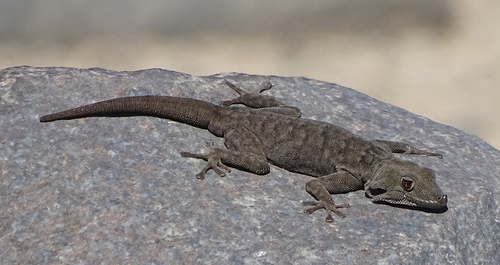
Pachydactylus rangei, commonly called the web-footed gecko, reaches a total length of approximately 13 cm (5 in), with a 6-centimetre (2.4 in) tail.
Head and Body Shape
Its head is clearly distinct from its slender body, and both the head and body are flattened along the dorsal side.
Eye Structure
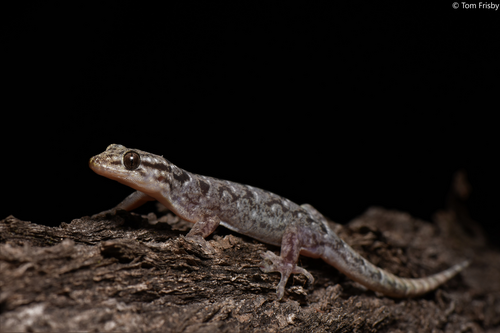
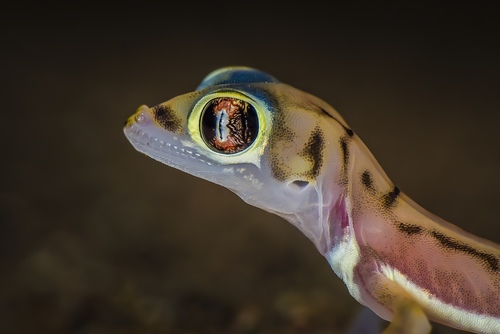
It has large, dark, protruding eyes with vertical pupils.
Base Coloration
This gecko is very pale and nearly translucent, with a salmon-colored undertone; some individuals have light brown stripes or patterns.
Camouflage Function
This skin coloration provides excellent camouflage against the sand of the Namib Desert.
Scale Characteristics
Its skin is covered in fine, smooth scales and is translucent enough that some internal organs are visible through it.
Webbed Foot Structure
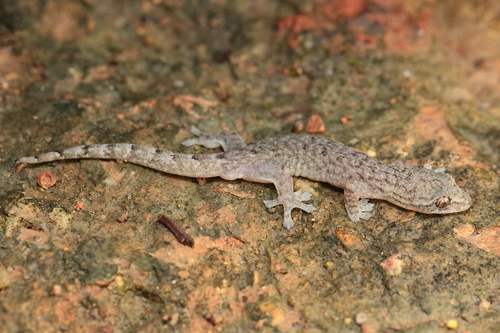
It has thin legs, but broad feet with fully webbed toes, an adaptation that lets it burrow easily and run across loose sand.
Webbed Foot Function
The webbed feet evolved to help the gecko stay on the surface of Namib Desert sand, or bury itself beneath it.
Nocturnal Behavior Context
This adaptation developed because the species is nocturnal: it spends daylight hours in self-dug burrows, and emerges to feed on the sand surface at night.
Adhesive Foot Pads
The undersides of its feet also have adhesive pads to aid climbing.
Sexual Dimorphism in Tails
Males have thicker tails than females.
Sexual Dimorphism in Mass
Females can reach a mass of around 10 grams, while males average approximately 6 grams.
Dorsal and Ventral Color Pattern
The head and dorsal surface are pinkish-brown with darker markings, most notably two intermittent lateral lines; the ventral surface is off-white.
Head Color Marking
A bluish band often runs between the gecko's eyes.
Similar Species
This species looks quite similar to Ptenopus garrulus, another gecko species that occurs within its range.
Endemic Range
Pachydactylus rangei is endemic to the Namib Desert of Southern Africa.
Distribution Details
It is found near the coast, and extends up to 130 kilometres (80 miles) inland at altitudes no higher than 300 metres (1,000 feet).
Type Locality
Its type locality is Lüderitz, Namibia.
Habitat Types
It inhabits areas around rocks and stunted vegetation, as well as the dry loose sand of sand dunes.
Preferred Habitat
The gecko prefers sandy desert regions, and is only found in coastal Namibia and the Richtersveld, located in the extreme north of Namaqualand in the Cape.