About Pachycormus discolor (Benth.) Coville ex Standl.
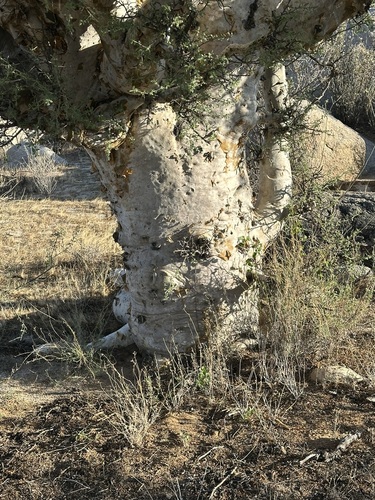
Pachycormus discolor (Benth.) Coville ex Standl. is most often a tree, and rarely a shrub, with a gnarled growth habit that can develop into unusual, irregular shapes. In areas with strong coastal winds along the Pacific coast, this species typically grows prostrate or sprawling. Its trunk usually measures 60 to 80 cm (24 to 31 in) in diameter, and is covered by a smooth, exfoliating, skin-like outer bark. Beneath this papery outer bark, which sheds annually, is a spongy blue-green photosynthetic inner bark that is 2.54 to 5.08 cm (1.00 to 2.00 in) thick. The inner bark produces a milky sap that dries clear and hardens into a gum or resin. Its leaves are dark green, pinnately compound, pubescent, and drought deciduous, turning yellow before dropping. Leaves hold 3 to 15 leaflets that are 3 to 10 mm (0.12 to 0.39 in) long, shaped oval or oblong. All above-ground plant tissue is covered in fine short hairs. Leaf size varies between infraspecific taxa of this species. The inflorescence is a panicle. Flowers are dioecious, and may be yellowish, pink, or red, with flower color varying by variety. Petals are accrescent, around 5 mm (0.20 in) long, with an acute tip. Fruits are shorter than petals and pubescent. Flowering starts in May, and can continue into September depending on available moisture. This species is endemic to the Baja California peninsula of Mexico, found in the states of Baja California and Baja California Sur. Its three varieties are each endemic to separate regions of the peninsula. The northern limit of the entire species is near San Fernando Velicatá; variety pubescens ranges from this point south to the lower peninsula near La Paz, and also grows on various Gulf of California islands. Variety veatchiana occurs in the far western part of the peninsula, occupying the western margins of the Vizcaino desert, Cedros Island, and the Natividad islands. Variety discolor is native to the southwestern peninsula, where it grows on the islands of Magdalena Bay and the western flanks of the southern Sierra de La Giganta. The species is primarily restricted to the Baja California desert and the Vizcaino desert, but it can also be found in more temperate montane habitats, including the mountains of the Sierra de La Giganta and the Gulf islands. In the Sierra de La Giganta, variety discolor grows sparsely on mountainsides, but forms impenetrable groves in ravines, and occurs from sea level up to 460 m (1,500 ft) elevation. On Cedros Island, variety veatchiana grows in alluvial fans and canyons (where it reaches its tallest height) and also in coastal localities (where it grows in a prostrate form), within the desert areas of the island. In the north and central parts of the species' range, including Laguna Chapala in Baja California and San Ignacio in Baja California Sur, typical habitats have high summer daytime temperatures, usually 34 to 45 °C (93 to 113 °F), and mild winter nights where temperatures can drop to 3 °C (37 °F). Most precipitation comes from Eastern Pacific hurricanes between August and October; some years receive no rainfall at all, while other years get some winter rain from the north. Enthusiasts of caudiciform succulents grow this species in containers. It grows best in full sun. Only specimens grown from seed develop a caudex. The species is only marginally frost tolerant: it develops tip damage at 0 °C (32 °F), and dies at −4 °C (25 °F). In the past, large amounts of its bark were exported to Europe for use in tanning.