About Pachycondyla sennaarensis (Mayr, 1862)
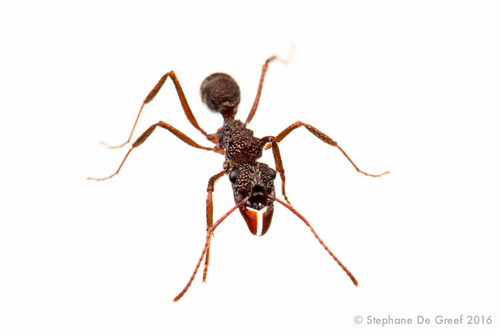
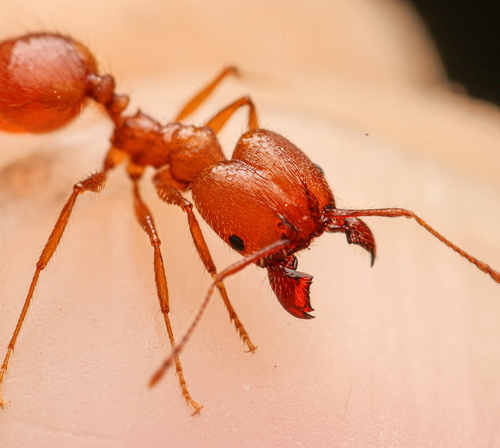
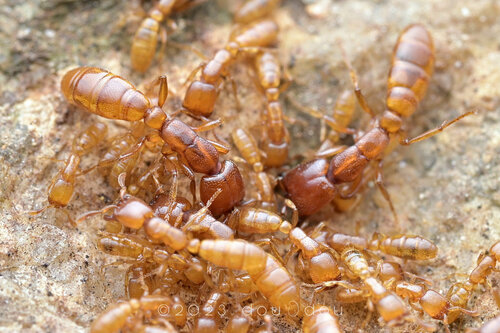
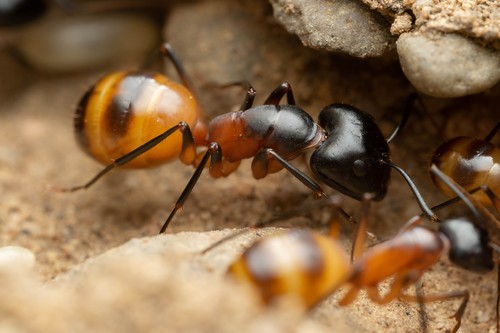
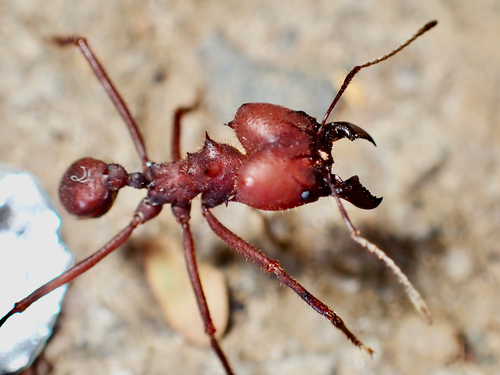
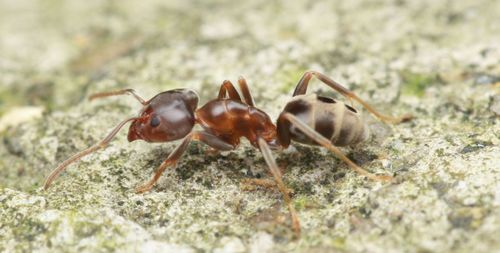
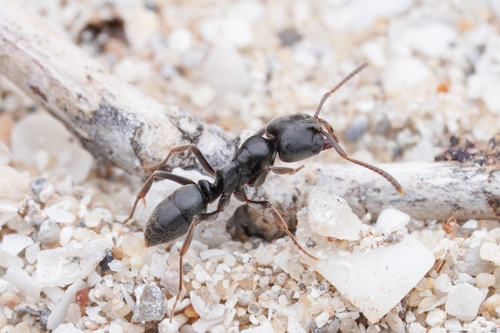
Pachycondyla sennaarensis, commonly called the samsum ant, has a body length of 5–6 mm (3⁄16–1⁄4 inch). Its body is dark brown to black-brown, while its antennae, tarsi, and tibia are red. The head is broader than the mesosoma. This is a ground-dwelling species that cannot climb smooth vertical walls, because it lacks adhesive pads on its tarsi and has only small arolium glands. It has straight pretarsal claws with an average claw tip angle of 56 degrees, and its ventral tarsal surface has no fine hairs. Samsum ants are polymorphic, with three castes: male, queen, and worker. A size difference between workers and queens distinguishes this species, a trait considered rare among ponerine ants. The common name "samsum ant" is used in the Middle East; the Arabic word صمصام (samsum) translates to "sharp sword", which likely refers to the ant's stinger. This ant is known for its powerful stings, which can very rarely cause anaphylactic shock and death. Samsum ants sting in self-defense, and cases of anaphylaxis from their stings have been reported globally. Because of this, the species is classified as a common household pest in multiple regions, and it is one of the few ponerine ants considered invasive. Both males and females have wings, and nuptial flights occur shortly after rain. Colonies contain both large and small workers. A study published in the Journal of Zoology in the Middle East found samsum ant colonies along irrigation ditches on damp ground in Iran. Nest entrances are circular with a diameter of 3–5 mm (1⁄8–1⁄4 inch). Colonies are large, averaging around 1,000 workers per colony. Samsum ants are omnivorous scavengers. They typically prey on small arthropods, including other ant species, and occasionally hunt larger arthropods such as cockroaches, subduing prey with their stingers. They also feed on the seeds of various plants, a feeding behavior unique to this species among Ponerinae ants. This species demonstrates an evolutionary transition from the carnivorous diet typical of most ponerine ants to an omnivorous diet that includes seeds. Their diet is flexible, and they can shift between granivorous and carnivorous feeding based on environmental conditions. The species is distributed across Africa, the Arabian Peninsula, and Iran. It is widespread across Africa; Levieux & Diomonde (1978) described it as the most common ant species in Sudan. Originating from Northeast Africa, it has established large populations in Burkina Faso, Cameroon, the Democratic Republic of the Congo, Ethiopia, Gambia, Guinea, Iran, Niger, Nigeria, Saudi Arabia, Senegal, Somalia, the United Arab Emirates, and Yemen. It acts as an invasive species in the United Arab Emirates and Saudi Arabia, where it threatens endemic Arabian ant species. The species was first recorded in the United States in 1943. Its broad distribution across urban areas of Africa and Asia has led to it being classified as both a tropicopolitan and cosmopolitan species, and one of the most abundant animals in human settlements in these regions. Its widespread spread is attributed to being one of the few omnivorous ponerine species with a flexible diet.