About Pachycereus schottii (Engelm.) D.R.Hunt
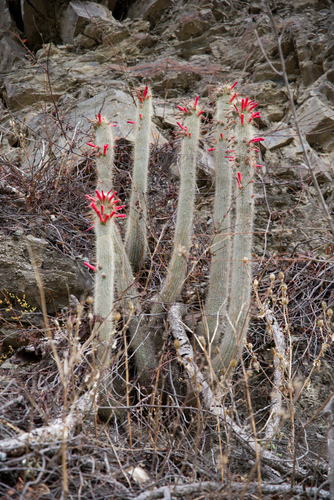
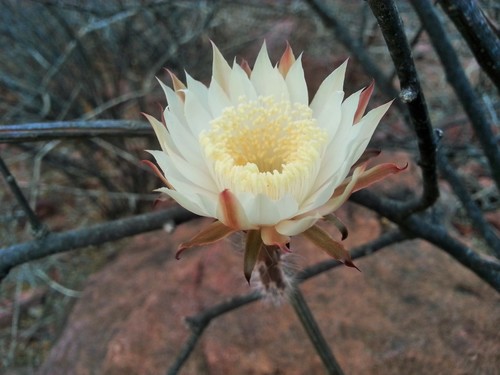
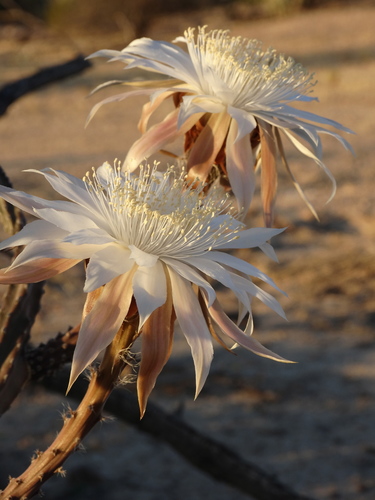
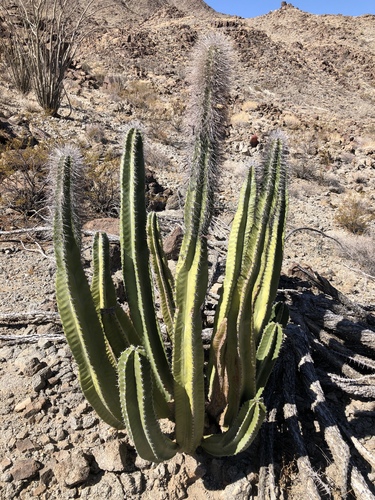
Pachycereus schottii, previously published under the synonym Lophocereus schottii, grows as a tree-shaped to shrub-like cactus. It has yellow-green, more or less upright shoots that often form thickets containing over 100 individual shoots. Mature plants reach heights of 1 to 3 meters, with shoot diameters ranging from 5 to 10 cm (2.0 to 3.9 inches). A distinct trunk is rarely formed. It has 4 to 13 clearly defined ribs. There are 1 to 3 strong, gray central spines, each 1 to 3 cm (0.39 to 1.18 inches) long, and 3 to 5 gray marginal spines, each 0.5 to 1.5 cm (0.20 to 0.59 inches) long. A terminal pseudocephalium is made up of bristly, flexible gray spines, and it can occasionally grow longer than 100 cm (39 inches). Funnel-shaped flowers emerge laterally from the pseudocephalium and open at night. The flowers are white to deep pink, reaching up to 5 cm (2.0 inches) in length and 3 cm (1.2 inches) in diameter. Both the pericarpel and flower tube are covered in scales and hairs. The spherical, red fruits contain red pulp and reach 1 to 3 cm (0.39 to 1.18 inches) in diameter. The fruits are edible, but are rarely used as food. The distribution of Pachycereus schottii ranges from southern Arizona in the United States to northwestern Mexico, covering the Mexican states of Baja California and Sonora. It grows at altitudes between 0 and 800 meters. This species, commonly called the senita cactus, has a mutualistic ecological relationship with the senita moth. The senita moth is the only nocturnal pollinator of the cactus, and the moth relies on the cactus as a host for reproduction.