About Pachycereus pecten-aboriginum (Engelm. ex S.Watson) Britton & Rose
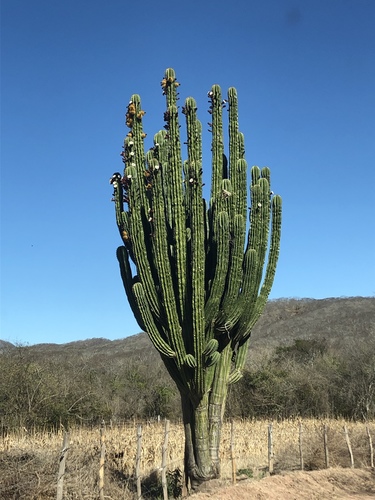
Pachycereus pecten-aboriginum is a tree-like cactus that can grow up to 15 meters tall, with many branches. Its erect or ascending branches reach up to 25 cm (9.8 in) in diameter, and the plant develops a trunk that can be as much as 2 meters across. Immature deep green stems grow up to 22 cm wide, and have 10 or 11 ribs. Mature stems are up to 17.5 cm wide, with 9 to 13 cm (3.5 to 5.1 in) in diameter, and 10 to 12 slightly rounded ribs. Areoles on the stems produce rigid, sharp spines that range from white to gray, are 1 to 3 cm (0.39 to 1.18 in) long, and may be curved on mature stems. There are eight to nine grayish radial spines per areole, growing up to 1 cm (0.39 in) long. The species produces white flowers that are 5.0 to 7.5 cm long. Flowers open in the evening and close by midday; the ovary is covered in velvety brown hairs, and linear floral bracts with long-attenuated tips enclose developing flower buds. Flowering occurs from January through March. The fruit is densely covered in long golden yellow spines that can be up to 6 cm long, and ripens in June and July. When mature, the fruit splits open to reveal a thin layer of firm, red, juicy pulp and shiny black seeds, each about 0.5 cm long. This cactus is endemic to Mexico. Its range extends across western Mexican states, from Baja California through Sinaloa and Sonora to Chiapas. It grows in the Chihuahuan and Sonoran Deserts, the thorn forest of Sinaloa, and the southern Sonoran plains. It can be found on slopes, plains, hills, and flat land, as well as in valleys, arroyos, and canyons. Its native habitats include thorn scrubs, tropical deciduous forests, and Sonoran desert scrub. It is especially abundant in the subtropical scrub of southern Sonora, particularly in the foothills and lower mountains. The fruit of Pachycereus pecten-aboriginum is edible; it can be eaten raw or cooked, and made into syrup, preserves, jam, or wine. The Mayo people traditionally ground the cactus's seeds into flour, mixed the flour with cornmeal to make tortillas, and used this etcho-seed flour for breakfast foods like pancakes. The Mayo also use this cactus as an herbal remedy. Pieces of the cactus flesh are applied to wounds to stop bleeding. Cactus flesh cooked in salted water produces a solution that is applied to infected wounds three times a day, followed by a dusting of sulfathiazole powder. The cactus juice is consumed as an herbal tonic and to treat sore throat.