About Pachnoda marginata (Drury, 1773)
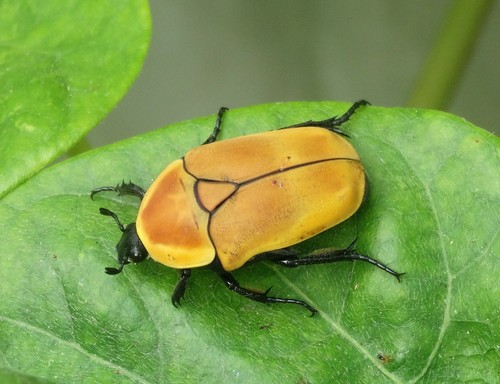
Pachnoda marginata, commonly called the sun beetle, has nine subspecies total. Three of these subspecies are the most common: Pachnoda marginata aurantia, Pachnoda marginata marginata, and Pachnoda marginata peregrina, and these three vary in coloration. Pachnoda marginata aurantia ranges in color from orange to yellow-orange; many individuals have a hue gradient toward the middle of their bodies, as shown in the diagram below. Pachnoda marginata marginata is normally red or crimson, and shows very little color variation between individual beetles. Pachnoda marginata peregrina is the most common of these three subspecies; it is pale yellow or orange with brown spots: one spot sits on the thorax, and two spots appear on each elytron (the hardened wing covering of each wing). Sometimes the spots on the elytra are almost unnoticeable, because they blend in with the surrounding body coloration. This faint spot pattern can be seen in the bottom-left picture of Pachnoda marginata peregrina in the terrarium section labeled "As pets". When sun beetle larvae build their cocoons, they can sometimes produce a low noise that sounds like snoring. After mating, a female sun beetle lays an egg in moist ground. The egg hatches after a short period of time, producing a larva that feeds heavily for 2 to 5 months. Once the larva is fully mature, it enters a pupal stage that lasts several weeks, then develops into an adult beetle. Adult sun beetles live for several months. Not all larvae successfully complete pupation; many die before they can molt into the pupal form.