About Pachira aquatica Aubl.
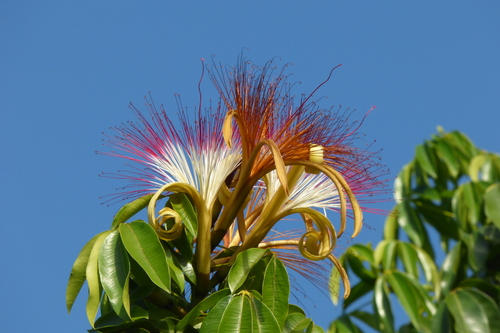
Pachira aquatica Aubl. can grow up to 23 meters (75 feet) tall, reaching 70 centimeters (28 inches) in diameter at breast height. It has shiny green palmate leaves made of lanceolate leaflets up to 30 centimeters (12 inches) long, and smooth green bark. This species develops a slightly thickened primary root with smaller lateral roots that acts as a water reservoir. Mature bark is relatively smooth, ranging from brown to gray and slightly cracked, while young branches are green. When grown outdoors, it produces a broad crown. Its transitional, long-stalked, palmately compound, slightly leathery leaves grow clustered at the ends of branches. The leaf petiole can reach up to 24 centimeters (9.4 inches) long. Leaves are bright green and shiny, and consist of up to nine leaflets. The mostly hairless, short-stalked leaflets grow up to 28 centimeters long, with tips ranging from rounded, rounded-pointed, to sharply pointed; their shape is lanceolate or obovate, with a pale midrib. Sloping stipules are present on leaves. Both the leaves and flowers of this species are often eaten. Its showy flowers are reported to carry a lilac-like fragrance, with long narrow petals up to 32 centimeters (13 inches) long that open like a banana peel to reveal hairlike yellowish orange stamens. These are large, short thick-stalked hermaphroditic flowers with double perianth, colored greenish-yellow or cream; their long stamens give them a shape resembling shaving brushes. Flowers grow terminally, either singly, in pairs, or in groups of three, and bat pollination is suggested for this species. The externally fine-haired, green-brown, overgrown calyx is cup-shaped and around 2 centimeters long. Narrow elongated petals can reach up to 30 centimeters long, though specimens with petals up to 34 centimeters (13 inches) long and 5.5 centimeters (2.2 inches) wide have been recorded on Barro Colorado Island. There are approximately 180 to 250 stamens, which are deep pink at the tip and yellow at the base, with elongated anthers growing overgrown and tufted at the top. The five-chambered ovary is superior, topped with a long style that ends in a divided, short-lobed stigma. The fruit is a large, woody, egg-shaped brown capsule with a rough surface, measuring 20 to 30 centimeters long, 10 to 15 centimeters in diameter, weighing around 1 to 1.5 kilograms, and holding 10 to 25 nuts. Many ornamental houseplants labeled as Pachira aquatica are actually the closely related species Pachira glabra. Both species are used as ornamentals, but the commonly braided houseplant called a "money tree" originally exported from Taiwan is Pachira glabra. Its misidentification as Pachira aquatica comes from an early error in classification in Taiwan. Plant author Wang Jui-min explains that for a long time this plant was mistakenly believed to be the Central and South American Pachira aquatica, and it was later discovered that the stamens of Malabar chestnut (Pachira glabra) are red and its fruit is covered in reddish-brown hairs, which differs significantly from the description of Pachira aquatica. Wang notes that all species cultivated as money trees in Taiwan are actually Pachira glabra. Pachira aquatica grows well as a tropical ornamental in moist, frost-free areas, and can be propagated from seed or cuttings. It is a durable plant that adapts well to a range of growing conditions. It needs bright light, but not direct full sunlight. When moved from indoor to outdoor growth, it must be gradually introduced to direct sunlight very slowly to lower the risk of leaf sunburn. This species thrives in both standard potting soil and hydroponic water-based cultivation. It grows well in bright light, and also tolerates partial shade, at room temperatures ranging from 12 °C to 25 °C. Leaf yellowing and drop in shorter autumn days is not a sign of disease, and the plant will resume healthy growth the following spring. Trees reach maturity at 4 to 5 years old, and produce their first fruit in spring and fall. Pachira aquatica can tolerate temperatures as low as 5 °C without losing leaves, though it is generally not recommended to grow it below 12 °C when grown as an orangery tree; the ideal year-round cultivation temperature is around 20 °C with high humidity. Occasional weak frost will cause leaf loss, and the tree will regrow new leaves the following spring. This species is occasionally cultivated for its nuts, which form inside its large woody capsule. The nuts are light brown with white stripes, around 2 to 3 centimeters long, embedded in a spongy, fibrous pericarp. The capsule itself is not eaten. Nuts develop inside the capsule until it splits open to release the seeds. The nuts are considered edible, with a flavor similar to European chestnut. Some people grind the nuts to use in a hot drink. Raw nuts are toxic to rats, but humans consume them both raw and roasted.