About Ozothamnus diosmifolius (Vent.) DC.
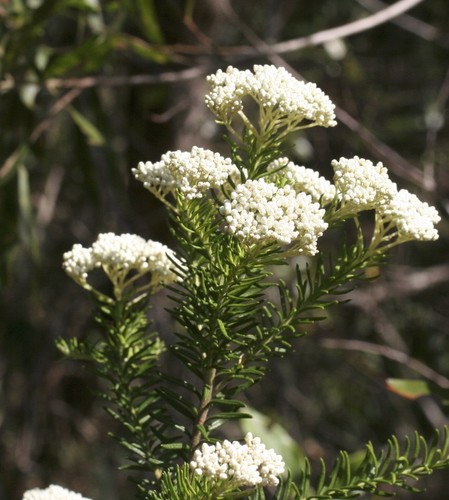
Ozothamnus diosmifolius is an erect, heavily branched woody shrub. It usually grows to a height of 2 meters (7 feet), though it may sometimes grow significantly taller. Its branches have a rough texture and are densely covered in short hairs. The leaves of this species are sharp-smelling, typically 10–15 mm (0.4–0.6 in) long and 1–2 mm (0.04–0.08 in) wide; forms growing inland have leaves that reach up to 3.5 mm (0.1 in) wide. Like other members of the Asteraceae family, what appears to be a single flower is actually a clustered head of tiny flowers, each individual head 2–3 mm (0.08–0.1 in) in diameter. In this species, these flower heads are arranged in corymbs, which form branched clusters that contain anywhere from a few to hundreds of individual flower heads. The white or pinkish color of the clusters comes from the papery ray florets surrounding each individual flower head. Ozothamnus diosmifolius is widespread across the coast, tablelands, and western slopes of New South Wales and Queensland, ranging north from Eden to Wide Bay. It grows in heath and on the edges of rainforests, most often on ridges. In this species, pollen is released at a different time of day than when the stigma becomes exposed, which improves the likelihood of cross-pollination. Before the mid-1980s, this species (known as rice flower) was extensively harvested from wild populations for the cut flower trade. After research was conducted on the species, commercial cultivation began in 1990. By 1999, there were around 100 growers, and exports, which were sent mainly to Japan, had increased to roughly 600,000 stems annually.