About Oxyura australis Gould, 1837
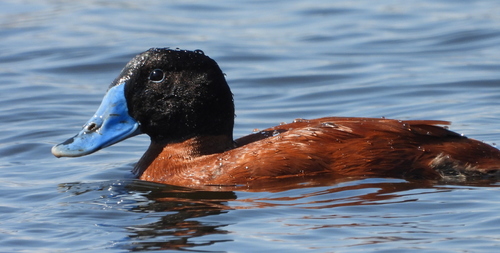
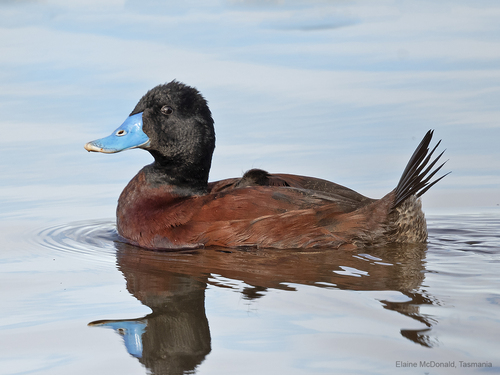
Both male and female blue-billed ducks (Oxyura australis) have tail feathers made of thick, spine-like shafts. The tail is usually held flat on the water, but held erect when the duck is defensive; males also hold their tail erect during courtship displays. Their powerful feet help with swimming and diving, and this species sits lower in the water than other ducks. During breeding season, males have a bright-blue bill, glossy black head and neck, and rich chestnut back and wings. During non-breeding season, males change to black heads with grey speckles and dark grey bodies, though some males keep breeding plumage all year round. Female plumage does not change across the year: females have dark brown heads, and back and wing feathers that are black with light-brown tips, creating a mottled appearance (a National Parks and Wildlife publication on O. australis notes bands on each feather instead of colored feather tips). Females have dark grey-brown bills and grey-brown feet, while males have grey feet. Both sexes have brown irises. Juvenile blue-billed ducks look similar to adult females but are paler and have grey-green bills. The blue-billed duck is endemic to temperate regions of Australia. Its range stretches from southern Queensland, through New South Wales and Victoria, to Tasmania, and it is also widespread in south-western Western Australia. It rarely appears on the New South Wales coastline except during drought, and is most abundant in the Murray-Darling basin. The species is almost entirely aquatic. While it has been observed on land, it has difficulty walking and moves with a penguin-like gait. During non-breeding season in autumn and winter, large flocks of several hundred ducks (especially juveniles and younger adults) gather in open lakes or dams far from shore. During the breeding season for the rest of the year, the blue-billed duck prefers deep, freshwater swamps with dense vegetation, including the cumbungi species Typha orientalis (broadleaf cumbungi) and Typha domingensis (narrow-leaved cumbungi). It has also been recorded in lignum swamps in more coastal areas, particularly in drier seasons, and is occasionally found in large rivers and saline water bodies such as billabongs. The behaviour of O. australis changes based on its breeding cycle. When not breeding in winter, ducks gather in large flocks on lakes, though some mature adults stay in vegetated swamps to continue breeding. In this open non-breeding habitat, they fly more often and escape threats by flying. When breeding, O. australis is secretive and wary, and will quickly and quietly dive underwater to escape threats rather than flying, resurfacing far from the original spot. The blue-billed duck produces a low quack that is rarely heard. Males have a very complex and elaborate courtship display, which includes rolling the cheek against the back, dab-preening (a behavior also sometimes performed by females), and sousing: throwing the head into the water in a prone position, arching the back as if in spasm, with legs potentially throwing spray above the body. After the courtship ritual and a vigorous chase, copulation occurs with the female completely submerged; the birds then separate and preen themselves. Before laying eggs, the female builds the nest, and the male mostly leaves the female at this point. There is evidence that O. australis is partially migratory, moving from breeding swamps of inland New South Wales to the Murray River during autumn and winter. Frith states that O. australis is the most migratory of all Australian ducks. Marchant and Higgins dispute this claim of regular yearly migration, noting that movement is driven by juveniles and young adults searching for new breeding grounds, especially on the edges of the species' range, while mature breeding adults often stay in place. Experienced dominant adult ducks are sedentary in breeding swamps, because migration would use energy that could instead be spent on breeding. Continuous year-round laying by captive adult ducks confirms that adults can be sedentary and breed opportunistically through the whole year. Laying timing in wild ducks varies with water levels and resulting food abundance, which contradicts Frith's description that reproduction is limited to the months between September and November. According to Marchant and Higgins, clutch size ranges from 3 to 12 eggs, with 5 to 6 being most common. Large clutch sizes occur when two females lay eggs in the same nest. Females sometimes practice what is called facultative parasitism, laying dump clutches in nests other than their own to take advantage of another female's incubation work. There is also some evidence that blue-billed ducks lay their eggs in nests occupied by other water-bird species. Incubation lasts 26 to 28 days. After hatching, ducklings stay in the nest for one day, then the female leads them out of the nest. Young ducks are relatively independent from their parents and can feed themselves immediately. The female protects her brood, including hatchlings from dump clutches laid by other females. At eight weeks old, ducklings are a similar size to adult blue-billed ducks. Most develop full adult plumage within one year, and captive yearlings have been observed to be able to breed.