About Oxyria digyna (L.) Hill
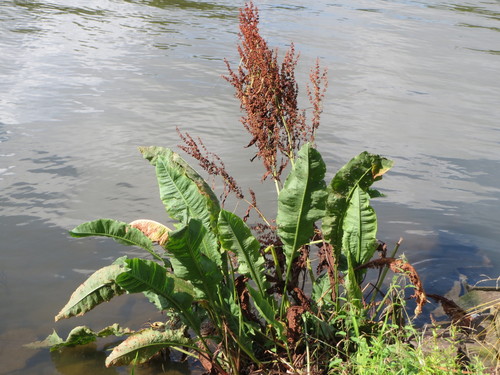
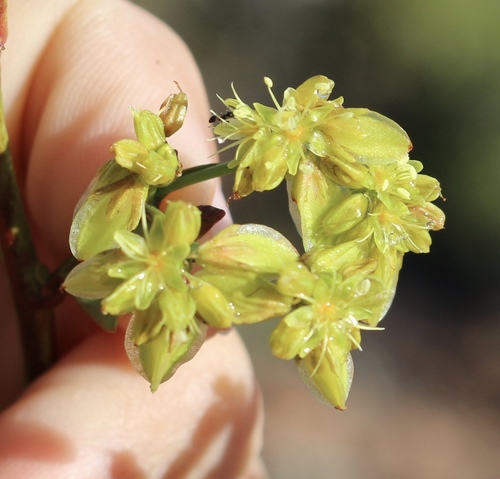
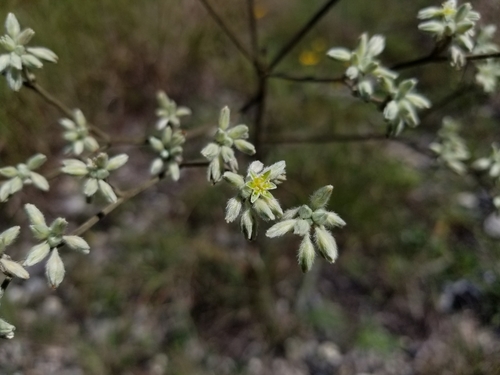
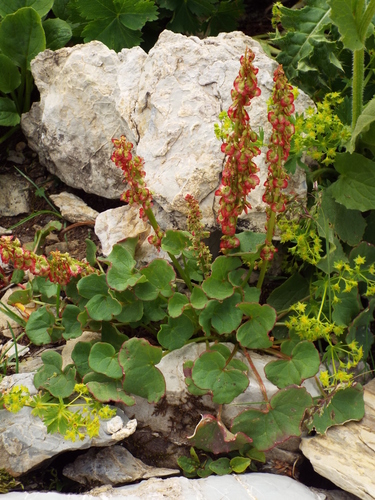
Mountain sorrel, scientifically named Oxyria digyna (L.) Hill, is a perennial plant with a tough taproot. It reaches a height of 10 to 30 cm, or 4 to 12 inches, and grows in dense tufts. Its stems are usually unbranched and hairless, and both flowering stems and leaf stalks are somewhat reddish. Leaves are kidney-shaped, somewhat fleshy, and borne on stalks emerging from the basal part of the stem. Small flowers start green, then turn reddish, and are arranged in an open upright cluster. The fruit is a small nut encircled by a broad wing that eventually turns red. With its characteristic dense red tufts, this plant is easy to recognize. The generic name Oxyria comes from Greek and means "sour". This species grows in wet places that receive snow protection over winter. It is common in Arctic tundra, and has a circumboreal distribution further south, growing in high mountainous regions of the Northern Hemisphere including the Alps, the Sierra Nevada, and the Cascade Range. Its typical habitats are alpine meadows, scree, snow-bed sites, and stream banks. Pollen of this plant has been recovered from 12,600-year-old peat bogs on the coast of Norway, showing that it was one of the first species to colonize the area after ice age glaciers retreated. Deer and elk prefer to feed on this plant. The leaves of mountain sorrel have a sour or fresh acidic taste caused by oxalic acid, and are rich in vitamin C, containing approximately 36 mg of vitamin C per 100 g of leaves. Leaves can be eaten raw or cooked. The Inuit used these leaves to prevent and cure scurvy, and mountain sorrel has also been an important part of the traditional Saami diet. In the arctic and alpine regions where it grows, mountain sorrel is an important food source for both insects and larger animals that feed on it.