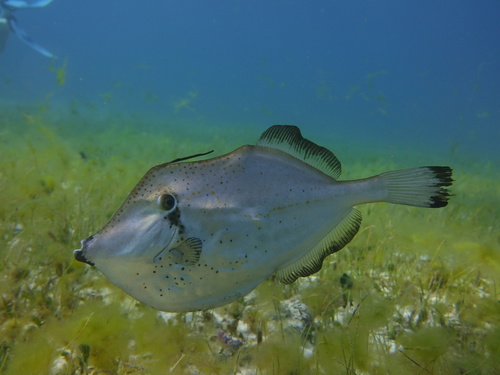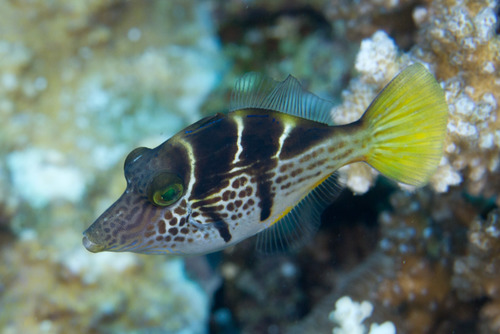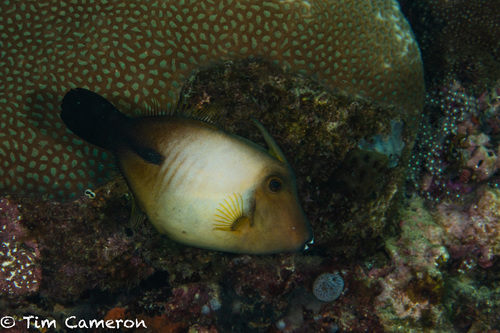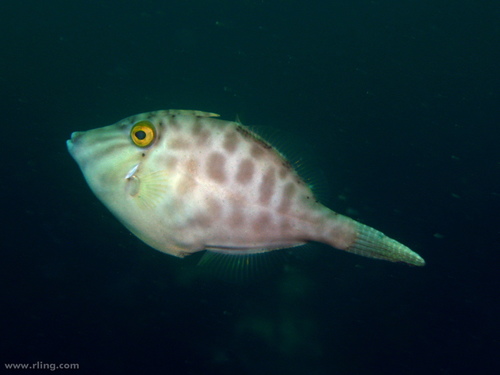
About Oxymonacanthus longirostris (Bloch & Schneider, 1801)
Body Coloration
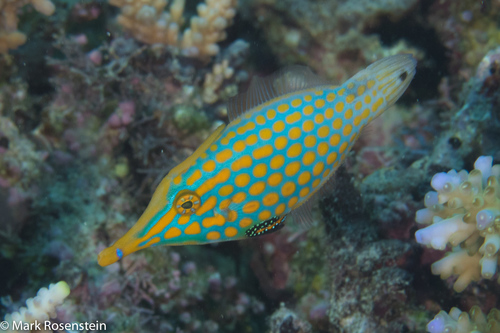
As its common name suggests, this fish has bright orange spots covering its blue-green skin, and even its eyes bear some orange lines.
Tail Spot Feature
Its pale tail has a distinct black spot that disappears when the caudal fin is flared out.
Pelvic Fin Structure
Instead of paired pelvic fins, this species has a black-bordered pelvic flap with white spots, reduced pelvic rays, and no pelvic spines.
Other Fin Structure
It has elongated dorsal and anal fins, while its pectoral fins are very reduced.
Locomotion Mechanism
Its large anal and dorsal fins help the fish move through coordinated undulation or oscillation.
Snout and Mouth Structure
The snout of O. longirostris is elongated, with a small mouth opening at its tip.
Tooth Structure
Its teeth are fused to form a hooked beak structure, with an extra tooth on each side.
Size Range
Males and females of this species are roughly the same size, typically ranging from 42mm to 75mm in length.
Sexual Dimorphism
This species shows slight sexual dimorphism: males have a slightly darker blue-green color and a bright orange ornamented area on the pelvic flap, while females have a duller orange ornamented pelvic flap area that is much smaller or even absent.
Habitat Range
The orange spotted filefish lives on shallow coral reefs in the Indo-Pacific.
Distribution Drivers
Two main factors shape this species' distribution: the availability of branching coral and overall coral richness.
Habitat Selection Factors
This means that habitat selection depends heavily on structural complexity and access to preferred prey, such as Acropora.