About Oxydendrum arboreum (L.) DC.
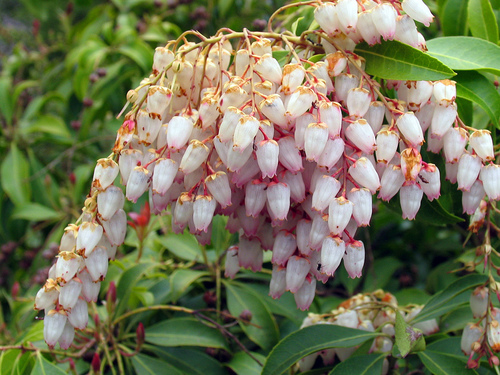
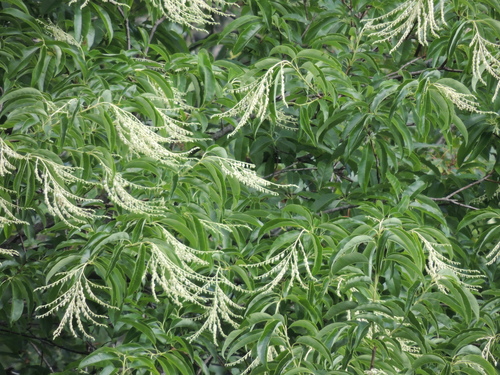
Oxydendrum arboreum, commonly known as sourwood, has gray bark with a reddish tinge that is deeply furrowed and scaly. Young branchlets are light yellow green, and mature branchlets turn reddish brown. Its wood is reddish brown with paler sapwood; it is heavy, hard, and close-grained, and can take a high polish. It has a specific gravity of 0.7458 and a density of 46.48 lb per cubic foot. Winter buds are axillary, minute, dark red, and partially embedded in bark; inner scales enlarge as spring growth begins. Leaves are alternate, 4 to 7 inches long, 1.5 to 2.5 inches wide, shaped oblong to oblanceolate, with a wedge-shaped base, serrated edges, and acute or acuminate tips. Leaf veins follow a feather-veined pattern, with a prominent midrib. New leaves emerge from buds in a revolute arrangement, and are bronze green, shining, and smooth when young; once fully grown, they are dark green and shiny on the upper surface, and pale and glaucous on the lower surface. In autumn, the leaves turn bright scarlet. Petioles are long and slender, and stipules are absent; leaves contain a high amount of acid. In June and July, cream-white flowers grow in terminal panicles made of one-sided secund racemes that are 7 to 8 inches long; the rachis and short pedicels are covered in downy fuzz. The calyx is five-parted and persistent, with lobes that meet edge-to-edge without overlapping in bud. The corolla is ovoid-cylindric, narrowed at the throat, cream-white, and has five teeth. Ten stamens attach to the corolla; filaments are wider than the anthers, and each anther is two-celled. The pistil has a superior, ovoid, five-celled ovary, a columnar style, and a simple stigma; a ten-toothed disk is present, and the ovary holds many ovules. The fruit is a downy capsule that is five-valved, five-angled, and tipped with the persistent style, on curving pedicels. Sourwood is hardy in northern climates and is a recommended ornamental tree for lawns and parks. Its late flowering and particularly bright, beautiful autumn coloring make it very desirable. Its leaves are high in acid content, and have a general arrangement similar to that of peach leaves. The leaves also act as a laxative. Sourwood is well known for the flavorful honey that bees produce from its flower nectar. Juice from its flowers is used to make sourwood jelly. Historically, the Cherokee and Catawba peoples used its shoots to make arrowshafts.