About Oxera splendida (F.Muell.) Gâteblé & Barrabé
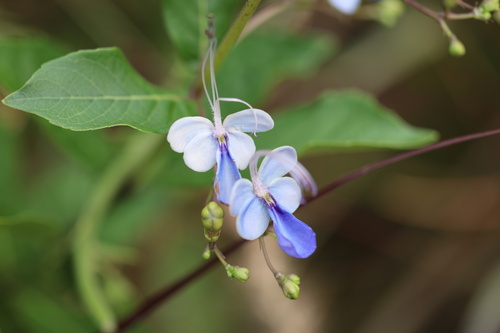
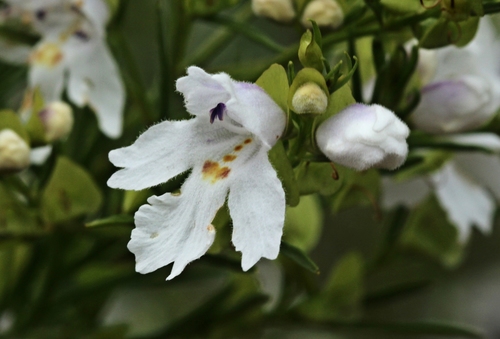
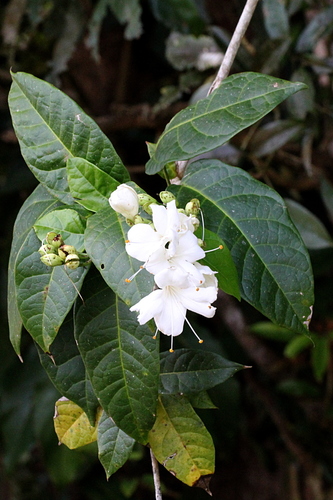
Oxera splendida is a woody, twining evergreen vine that can reach up to 15 cm (5.9 in) in stem diameter. Its glossy green ovate leaves grow in opposite pairs along the stem, reaching up to 24 cm (9.4 in) long and 13 cm (5.1 in) wide, attached by petioles up to 8 cm (3.1 in) long. The species flowers and produces fruit during the warmer months, from August to April. Its abundant white, fragrant flowers are short-lived, sometimes lasting only one day, and each flower measures approximately 4.5 cm across. The fruit is white and fleshy, about 8 cm (3.1 in) long and 5 cm (2.0 in) in diameter, shaped similarly to a potato or large egg. Each fruit contains a single large seed with a rough brown seed coat 1 to 3 mm (0.039 to 0.118 in) thick. This species is distributed across Sulawesi, the Moluccas, New Guinea, the Solomon Islands, and Queensland. It grows in rainforest, montane forest, and swamp forest at elevations ranging from sea level up to 2000 m. It tolerates both clay and humus soils, and can grow in both undisturbed primary forest and previously disturbed secondary forest. The white-fruited vine is commonly found along rainforest margins such as roadsides. Ecologically, Oxera splendida serves as a larval food plant for multiple Australian butterfly species: the dark forest-blue (Pseudodipsas eone), coral jewel (Hypochrysops miskini), shining oak-blue (Arhopala micale), black-spotted flash (Hypolycaena phorbas), and pale ciliate blue (Anthene lycaenoides). For Pseudodipsas eone specifically, butterflies actively seek out Oxera splendida leaves for their extrafloral nectaries, which produce nectar, and this butterfly only feeds on leaves that have these nectaries. Frugivores interact with the plant’s fruit in different ways. The spectacled flying fox feeds on the fruit but is too small to consume and internally disperse the whole seed, though it may carry fruit short distances to disperse it. The much larger Southern cassowary also feeds on this fruit – it is one of the largest fruit types the cassowary can ingest – and disperses the plant’s seeds over large distances. Both the fruit and seed are eaten by the musky rat-kangaroo, which is too small to swallow the whole seed and instead chews on it. This species is one of the prominent vine species that thrive in heavily cyclone-damaged forest, also called cyclone scrub. These forest areas typically have a low, uneven canopy from damage caused by intensified cyclonic winds, and multiple vine species grow into the open canopy here. Oxera splendida is cultivated as a decorative garden plant, valued for its attractive flowers and pleasant fragrance. When given plenty of sunlight and water, the vine is hardy and grows vigorously. For the Australian Aboriginal Girramay clan, this plant (called Djungeen vine by the group) acts as a seasonal indicator: when its fruit falls to the ground in October, bush turkey nests will contain eggs. Another traditional Aboriginal use is as a fish poison. To prepare it, the outer bark is removed, the middle bark layer is scraped off and rubbed onto a hot stone, and the stone is then thrown into a creek or small lagoon. All aquatic animals in the water are poisoned and die within an hour. A sapotoxin found in the plant's leaves, stems, and roots acts as the effective fish poison; it dissolves easily in water and remains effective even at low concentrations.