About Oxalis stricta L.
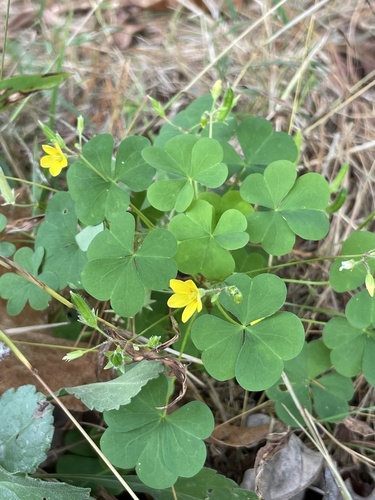
Oxalis stricta L., commonly called upright yellow woodsorrel, is an annual or short-lived perennial plant. It grows from short rhizomes and never forms bulbs. Its alternate leaves are divided into three characteristic heart-shaped leaflets, a trait shared by other Oxalis species, and leaflets can reach up to 2 cm wide. The leaves exhibit nyctinasty, curling up at night and opening during the day for photosynthesis. Its flowers are hermaphroditic and bloom from July to October. When disturbed, mature seed capsules open explosively—this trait is very similar to that of mature seed capsules or fruits of plants in the genus Impatiens—and can disperse seeds up to 4 meters (about 13 feet) away. The plant is erect when young, later becomes decumbent as it lies down, and branches regularly. It should not be confused with other similar species in the same genus that are also commonly called "yellow woodsorrel".
O. stricta is native to North America and East Asia, and has been introduced to other regions, especially Europe. It was not documented in Michigan before the 1890s. It most often grows in woodlands, meadows, and disturbed areas, growing as both a perennial and annual depending on conditions. It generally grows in dry or moist, alkaline soils, and prefers sandy and loamy soil. It requires well-drained soil and can grow in nutritionally poor ground. It is commonly considered a weed of gardens, fields, and lawns, and can grow in full sun or full shade.
All parts of the plant are edible, with a distinct tangy flavor common to all species in the genus Oxalis. The leaves have a mild, lemon-like flavor. It is often eaten while hiking or camping, where it is sometimes called lemon clover. However, it should only be consumed in small quantities, because it contains oxalic acid, an antinutrient that can inhibit the body's absorption of calcium. The sour flavor is eliminated when the plant is cooked. Leaves and flowers are sometimes added to salads for both decoration and flavoring. They can also be chewed raw, along with other parts of the plant except the root, as a thirst-quencher. Raw green pods are pleasant to eat, with a juicy crisp texture and tartness similar to rhubarb. Leaves can be used to make a flavored drink that tastes similar to lemonade, and the whole plant can be brewed into herbal tea that has an aroma somewhat like cooked green beans. Juice extracted from the plant's greens can be used as a substitute for common vinegar.
An orange dye can be obtained by boiling the whole plant.
Oxalis stricta contains large amounts of vitamin C, and has been used to treat scurvy. A poultice made from the plant has been used to treat swellings.