About Ourisia ruellioides (L.fil.) Kuntze
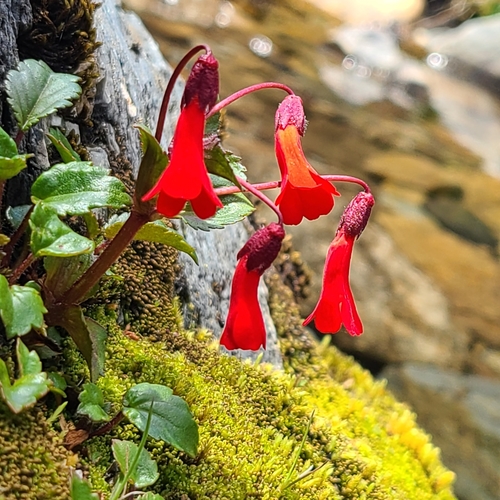
Ourisia ruellioides (L.fil.) Kuntze are perennial herbs that grow in an ascending to erect form. Their short stems are 1.9–4.3 mm wide, and can be either glabrous (hairless) or hairy. Leaves are arranged oppositely, tightly clustered, and borne on petioles; leaf blades measure 6.2–116.1 mm long by 4.4–71.3 mm wide, with a length-to-width ratio of 1.2–2.0:1. Leaf petioles are 6.3–250.0 mm long, and are usually either glabrous or covered in long non-glandular hairs. Leaf blades are most often narrowly ovate, ovate, or broadly ovate, widest below the middle, typically with an acute apex, a truncate or cordate base, and serrate edges. Both leaf surfaces are usually glabrous or bear a few long non-glandular hairs, and the lower leaf surface is also punctate. Inflorescences are erect racemes that grow up to 44 cm long. Each inflorescence holds 1–6 flowering nodes, with one or two flowers and 2 bracts per node. The bracts resemble smaller versions of the plant's leaves, measure 2.3–3.5 mm long by 0.8–1.6 mm wide, and are sessile. Flowers are borne on pedicels up to 62.5 mm long; pedicels are usually glabrous, and sometimes have a small number of short or long non-glandular or sessile glandular hairs. The calyx is 5.0–9.1 mm long, irregular, with 2 lobes divided all the way to the base of the calyx and 3 lobes divided between one-sixth and one-half the length of the calyx; it is usually glabrous apart from ciliate margins. The corolla is 18.8–28.9 mm long, including a 9.0–22.9 mm long corolla tube, and is subregular, straight or curved, and tubular. It is red with yellow coloring inside the tube, and is papillate and mostly glabrous on both its inner and outer surfaces. Corolla lobes are 1.7–9.6 mm long, do not spread or spread only slightly, and can be shaped rounded, rectangular, obovate, or obcordate. There are 4 didynamous stamens: the two longer stamens are exserted, or at minimum reach the opening of the corolla tube, while the two shorter stamens are included inside the tube, or reach the corolla tube opening. The style is 7.8–30.4 mm long and included inside the corolla, ending in an emarginate or capitate stigma. The ovary is 2.3–5.2 mm long. Fruits are glabrous capsules that open via loculicidal dehiscence; fruiting pedicels are 14.9–66.0 mm long. Each capsule holds approximately 160 seeds. Seeds are 1.2–2.0 mm long by 0.4–0.7 mm wide, elliptic, with a two-layered reticulate (net-like) seed coat that has thick, smooth, shallow primary reticula. Ourisia ruellioides flowers from September to March, and fruits from October to April. The recorded chromosome number for this species is 2n = 16. Ourisia ruellioides is endemic to the Andes mountains of southern Argentina and Chile, ranging from 34°S to 56°S latitude. Spanning 22 degrees of latitude, it is the most widespread and common species in the genus Ourisia. In Argentina, it occurs in the provinces of Neuquén, Río Negro, Chubut, Santa Cruz and Tierra del Fuego, including within several national parks. In Chile, it occurs in the regions of O'Higgins, Maule, Ñuble, Biobío, Araucanía, Los Ríos, Los Lagos, Aysén and Magallanes. O. ruellioides grows from 0 to 2600 m above sea level in wet, rocky, shady habitats, including Nothofagus forests, and often grows in or near running water. It is one of three Ourisia species that reach Tierra del Fuego, alongside O. fuegiana and O. breviflora subsp. breviflora. In Tierra del Fuego, it is common in two of the four main vegetational zones: evergreen forest and deciduous forest, and is found on several islands including Isla de los Estados.