About Ourisia macrocarpa Hook.fil.
Taxonomic Identity
Ourisia macrocarpa Hook.fil. is a large perennial herb species.
Stem and Leaf Arrangement
It has creeping horizontal stems, with opposite leaves that grow in tight tufts along the stems.
Leaf Petiole Dimensions
Leaf petioles measure 34.5–150.0 mm (1.36–5.91 inches) in length.
Leaf Blade Dimensions
Leaf blades are 12.3–135.1 mm (0.48–5.32 inches) long and 7.4–71.4 mm (0.29–2.81 inches) wide, with a length-to-width ratio of 1.0–1.7:1.
Leaf Blade Shape
Leaf blades are broadly to very broadly ovate, widest below the middle, with an acute apex, a rounded or cordate base, and regularly crenate edges.
Leaf Surface and Pubescence
Most leaves are glabrous (hairless), with only a fringe of non-glandular hairs on the lower leaf edges; the lower leaf surface is densely punctate, and sometimes non-glandular hairs are also present on the leaf midvein.
Inflorescence Structure
Its inflorescences are erect, typically consisting of glabrous racemes up to 61 cm (24 inches) long. Each raceme has 1–8 flowering nodes and can hold up to 32 or more total flowers.
Flowering Node and Bract Characteristics
Each flowering node holds up to 9 flowers, along with 3–9 sessile, clasping bracts that are usually lanceolate to narrowly ovate, or oblanceolate to obovate. The lowest bracts are similar in size and shape to the plant's leaves, measuring 12.2–240 mm long and 3.9–10.2 mm wide, and bracts become smaller toward the apex of the raceme.
Pedicel Features
Flowers are carried on pedicels up to 64.7 mm long that are either glabrous or hairy, with only non-glandular hairs present.
Calyx Morphology
The calyx is 7.5–12.2 mm long and irregular: two lobes are divided all the way to the base, while three lobes are divided to one-half to two-thirds of the calyx length. A small number to dense distribution of non-glandular hairs cover the smooth edges and base of the calyx.
Corolla Structure and Coloration
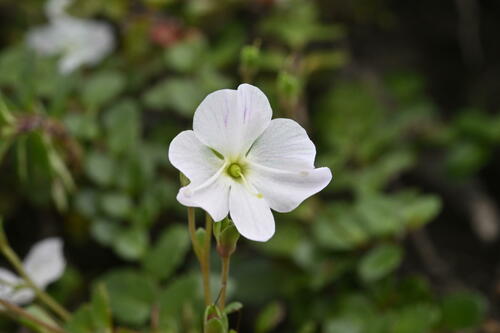
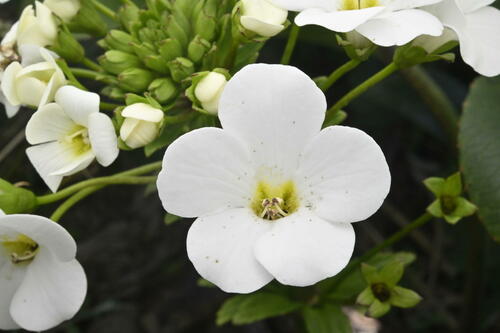
The corolla is 16.4–31.3 mm long (including a 5.7–16.1 mm long corolla tube), bilabiate, and tubular-funnelform. It is glabrous and white (sometimes pink-flushed) on the outside, and yellow on the inside with three lines of yellow hairs.
Corolla Lobe Shape
Corolla lobes are 5.9–15.3 mm long, spreading, and shaped obovate or obcordate.
Stamen Characteristics
There are 4 didynamous stamens up to 15.9 mm long: two long stamens are exserted, and two short stamens reach the opening of the corolla tube. A short staminode 0.5–4.1 mm long is also present.
Style and Stigma Features
The style is 5.5–10.7 mm long, and it is either exserted or reaches the corolla tube opening, with an emarginate stigma.
Ovary Traits
The ovary is 3.0–4.6 mm long and glabrous.
Fruit Characteristics
Fruits are capsules 5.0–9.9 mm long and 4.0–8.0 mm wide, that open via loculicidal dehiscence, and are carried on pedicels up to 80.5 mm long.
Seed Characteristics
Each capsule contains approximately 630 seeds; seeds are 0.4–1.3 mm long and 0.1–0.8 mm wide, with a two-layered, reticulate seed coat.
Flowering and Fruiting Period
Ourisia macrocarpa flowers from December to February, and fruits from December to March.
Chromosome Number
Its chromosome number is 2n=48.
Endemic Range
This species is endemic to the southern South Island of New Zealand, specifically found in Otago, Southland, and Fiordland.
Habitat and Elevation
It grows in wet habitats including subalpine herbfields, scrub, bogs, and grasslands, at elevations between 360 to 1,550 m (1,180 to 5,090 ft) above sea level.