About Oudemansiella canarii (Jungh.) Höhn.
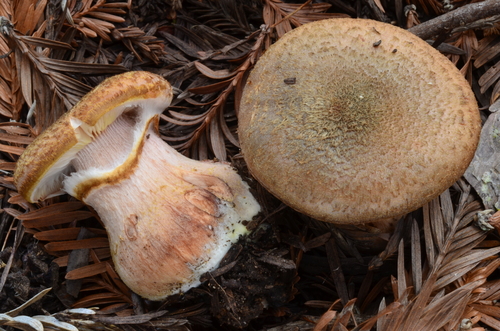
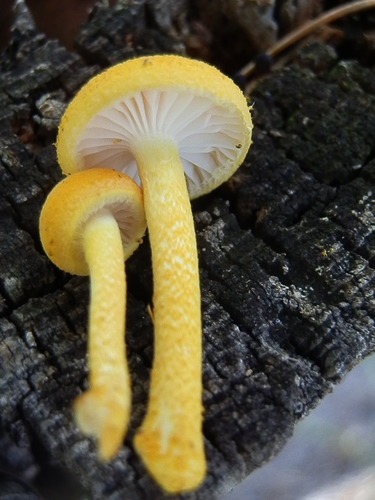
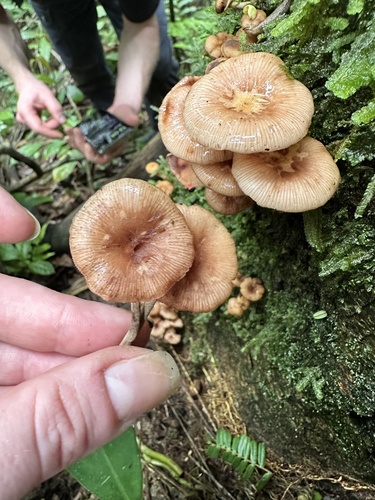
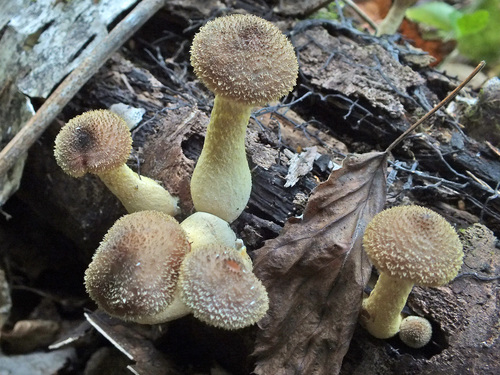
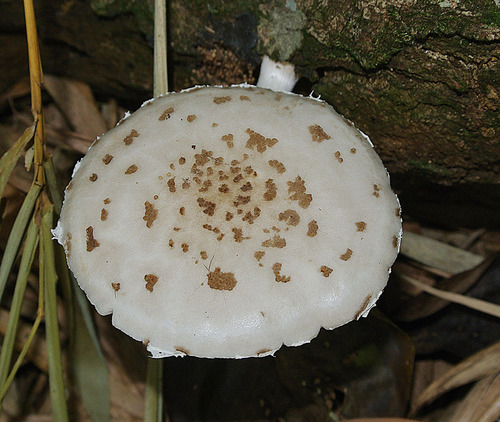
Oudemansiella canarii is a white, cap-bearing, stalked mushroom that grows on fallen, decaying, wet logs. Key identifying features include subdeccurent gills, a cap-bearing stalk, and both intact and ruptured warts on the cap. This species produces basidiospores. Its life cycle matches that of most other Agaricales: the primary mycelium formed by basidiospore germination is short-lived. It is haploid with septate hyphae; its cells are short, uninucleate, and contain oil globules and vacuoles. After hyphal fusion, the primary mycelium becomes binucleate, usually without clamp connections and only rarely with them. The mycelium made of binucleate cells is called secondary or dikaryotic mycelium. It is long-lived, abundant, produces mushrooms yearly, and consists of long, branched hyphae. These hyphae commonly interlace and twist to form thick, white hyphal cords called rhizomorphs, which support the fruiting bodies. Ecologically, this species is a saprobe that gets its energy from dead or decaying wood. It forms a commensalitic relationship with the bacterium Spirochaeta cytophaga: S. cytophaga breaks down cellulose in decaying wood, which O. canarii then uses for nutrition. O. canarii is readily found in tropical forests, or forests with hardwood trees such as evergreen. These habitats occur in tropical parts of the USA, Central America, South America, and parts of Australia. Its geographic distribution is concentrated mostly in tropical regions, including Argentina, tropical Central America, and tropical North America, with a smaller population in northern Australia.