About Oudemansiella australis G.Stev. & G.M.Taylor
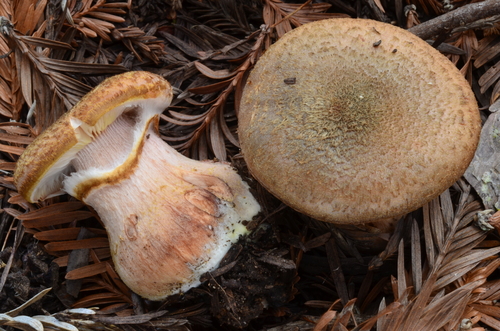
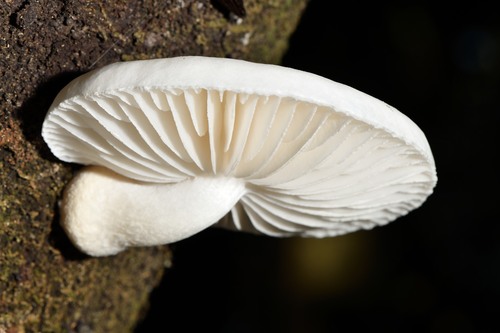
The mushroom Oudemansiella australis has a cap 3–5.5 cm (1.2–2.2 in) in diameter. Caps are initially white, fading to light yellowish brown (fawn) as they age. The cap is convex in shape, and splits at its margins. The cap cuticle splits irregularly to expose firm white flesh underneath. The gills are adnate, powdery white, and moderately distantly spaced. Long and short gills are intercalated, with deep ribs at the base. The stem measures 2.5 cm (1.0 in) long by 0.6–1 cm (0.2–0.4 in) thick, and is attached off-centre to the cap. The upper part of the stem is white, changing to fawn around its swollen base. The stem flesh is solid, white, and silky. This species produces a white spore print. Spores are spherical or nearly spherical, measuring 24 by 21 μm, with walls approximately 1 μm thick. They are non-amyloid, and have a prominent hilar appendix, which is the depression on the spore surface where it was once connected to the sterigmata. Oudemansiella australis grows on rotting wood. The first recorded collection of this species was made in an open area near a forest in Wainui Valley, Wellington. It has also been found in Australia and Papua New Guinea.