About Otus lettia (Hodgson, 1836)
The collared scops owl, with the scientific name Otus lettia (Hodgson, 1836), is a resident breeding owl native to South Asia. Its breeding range extends from northern Pakistan, northern India, Nepal, and Bangladesh, through the Himalayas eastward to southern China and Taiwan. This species is partially migratory, with some individuals wintering in India, Sri Lanka, and Malaysia.
It was formerly grouped with what is now recognized as the separate Indian scops owl (O. bakkamoena), and is still sometimes treated as a subspecies of Indian scops owl. It belongs to Strigidae, the family of typical owls which contains most of the world's owl species; the other major owl grouping is the barn owl family, Tytonidae.
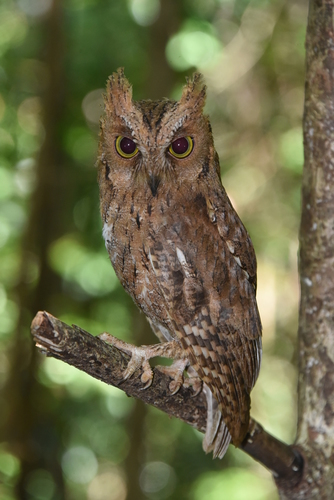
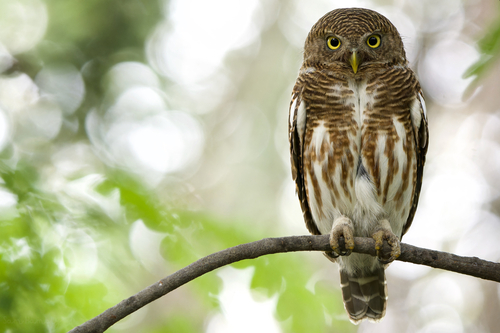
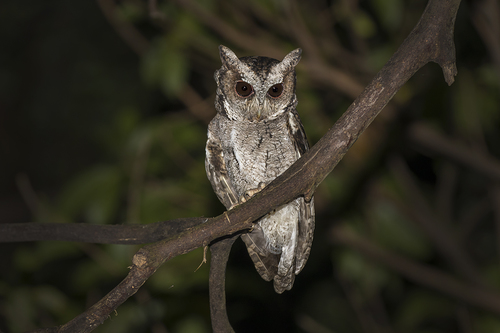
Collared scops owls are common breeding birds in forests and other well-wooded habitats. They nest in tree hollows, where females lay clutches of 3 to 5 eggs. This is a small owl, measuring 23–25 cm in length, though it is the largest species among scops owls. Like other scops owls, it has small head tufts, often called ear tufts. Upperparts are grey or brown depending on the subspecies, with faint buff spotting. Underparts are buff with fine darker streaks. The facial disc is whitish or buff, the eyes are orange or brown, and a distinct buff neckband is present. Males and females have similar plumage. The flight of this owl is deeply undulating.
The collared scops owl is nocturnal, but roosting individuals can often be found by the mobbing behavior of small birds that gather around it during the day. It feeds mainly on insects, and its call is a quiet 'goog gook'. This species is chiefly found in northern India; across the southern part of its former range, it is replaced by the very similar-looking oriental scops owl (Otus sunia), which was recently split from this species as a separate taxon. It is also extremely similar in appearance to the slightly smaller Indian scops owl, and the easiest way to tell them apart in the field is by their different calls.