About Otus elegans (Cassin, 1852)
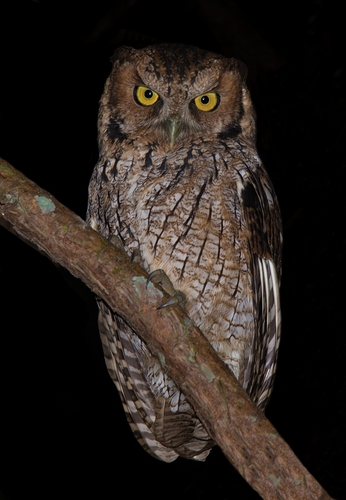
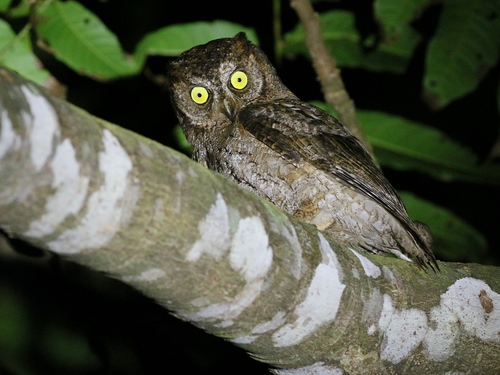
The Ryukyu scops owl, also called the Ryūkyū scops owl or elegant scops owl (scientific name Otus elegans), is a small rufous-brown owl. It has a brown facial disc, a cinnamon facial ruff, an olive-grey bill, and yellow eyes. The subspecies Otus elegans botelensis is territorial. Since their beaks cannot carve holes into trees, this subspecies mainly nests in naturally decayed tree hollows, or hollows previously created by other animals. Nest traces can occasionally be found in man-made structures, such as drainage holes or toilet water tanks. Their main diet consists of katydids, moths, millipedes, and other invertebrates. They occasionally prey on geckos, lizards, Japanese white-eye, and other small vertebrates. The distribution of Otus elegans botelensis is limited by the presence of naturally occurring tree hollows. Suitable hollows typically form in trees with a diameter at breast height (dbh) of over 38 cm. Different tree species provide different amounts of these suitable hollows for O. e. botelensis. Observations show that tree hollows are more likely to form in Pometia pinnata than in other tree species, so areas with large numbers of P. pinnata support higher population densities of O. e. botelensis. The species Otus elegans is found in tropical or subtropical evergreen forest, located on the Ryukyu Islands of southern Japan, Lanyu Island off south-east Taiwan, and the Batanes and Babuyan Islands off northern Luzon, Philippines. It is becoming increasingly rare as a result of habitat loss.